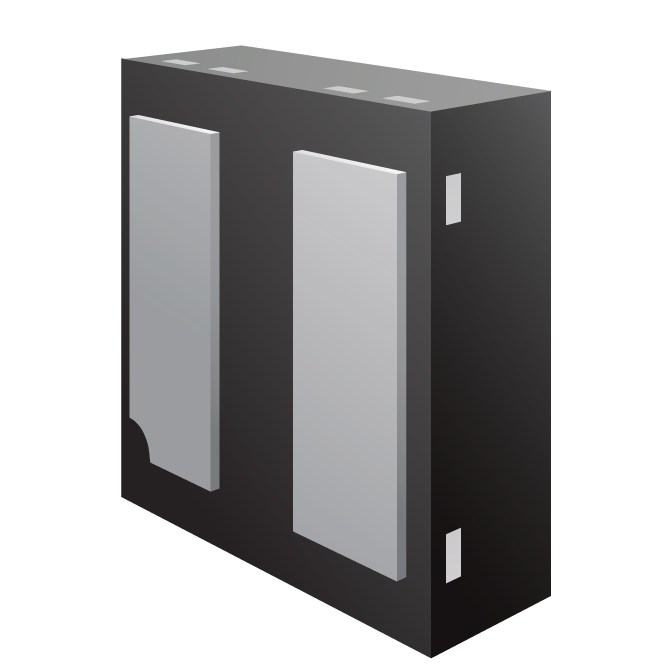
TDK has extended its portfolio of EPCOS ERU SMT power inductors with the ERU16 choke series that comprises ten different types. The inductance values of the new B82559*A016 series extend from 1.0 µH to 30 µH and their saturation currents range from 9.2 A DC to 37 A DC.
The outstanding feature of these new power inductors is their compact design: With a footprint of just 17.3 mm x 18.7 mm, they have low insertion heights of 7.55 mm (1.0 µH) to 10.95 mm (30 µH), depending on the type. This low-profile design is based on a flat rectangular helical winding technology which results in lower losses.
The DC resistances are between 1.05 mΩ and 15.35 mΩ. With the new ERU16 types TDK is expanding its broad spectrum of ERU SMT power inductors, which include the existing ERU13, ERU19, ERU20 and ERU25 series.
The new series of high-current chokes is designed for operating temperatures of between -40 °C and +150 °C. Its additional third soldering pad results in high mechanical stability on the PCB. They can be used as output and storage chokes in a wide variety of power supply topologies. These include point-of-load (POL) converters, DC-DC converters, high-current switch-mode power supplies, solar converters and xEV applications. The components of the new series are RoHS-compatible and qualified to AEC-Q200.
Main applications
Output and storage chokes for point-of-load (POL) converters, DC-DC converters, high-current switch-mode power supplies, solar converters and xEV applications
Main features and benefits
Compact dimensions thanks to flat rectangular helical winding
High saturation currents of up to 37 A DC
Low losses