TE Connectivity’s KILOVAC current-sensing high-voltage contactor offers current-trip function
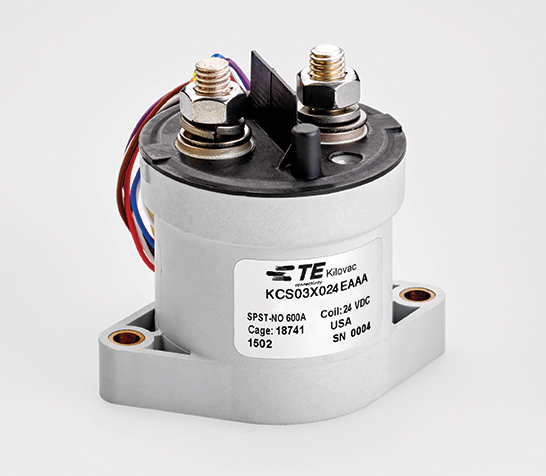
TE Connectivity, a leader in connectivity and sensors, recently introduced the KILOVAC current-sensing (KCS03) High-Voltage contactor, featuring an integrated current sensor with current trip function. KILOVAC current-sensing contactors eliminate the need for discrete current sensors, saving weight and space in military and commercial electric vehicles, power distribution and energy storage systems.
TE’s current-sensing contactors simplify configuration needs within rugged applications through its small size and flexible configuration. The sensor function includes a programmable trip, which allows immediate, delayed, or disabled trip. These contactors are hermetically sealed for reliable performance in most harsh, explosive and corrosive environments.
“TE’s KILOVAC current-sensing (KCS03) High-Voltage contactor, at 500 grams, is one of the smallest 600 A hermetically-sealed contactor in the industry,” said Earle Alldredge, product manager of global aerospace, defense & marine at TE Connectivity. “Its flexible configuration makes it ideal for a wide variety of applications, and it is well suited to many harsh environments.”
The 600 A/28 VDC – 600 VDC current-sensing contactors can be mounted in any orientation and include bidirectional switching capabilities to accommodate a range of applications. The integrated dual-coil electronic economizer with coil suppression is EMC compliant with no radiated coil emissions.