The latest ceramic capacitors tech combines stability with performance
Multi-Layer Ceramic Capacitors (MLCC) in chipscale surface-mount packages are widely used in electronics for consumer, medical, industrial, automotive, and other applications. Their combination of affordability, compatibility with high-volume assembly, high capacitance values within small dimensions, and high reliability meet the needs of a wide range of markets.
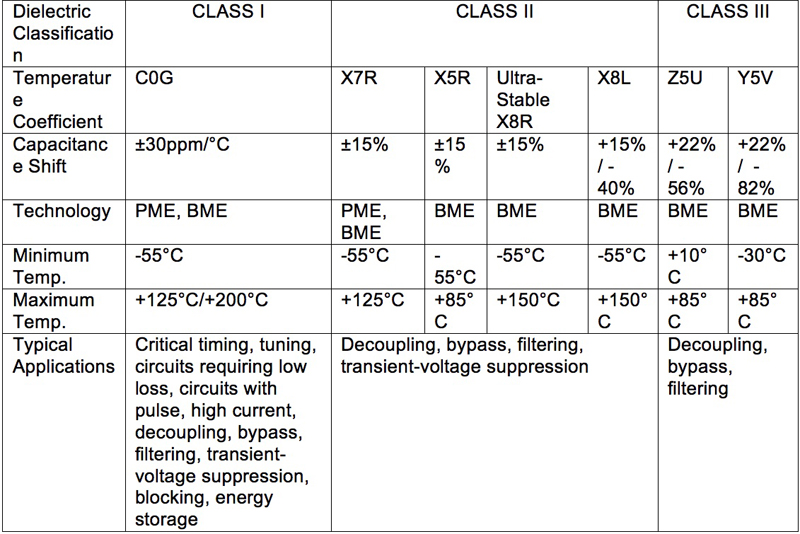
Key properties of MLCCs such as capacitance, size, and performance over voltage and temperature are determined predominantly by dielectric type. Other important factors include the electrode architecture, which influences resistance to phenomena like flex cracking and surface arc-over at high applied voltages. A variety of dielectrics have been developed, broadly grouped in three classes that enable designers to choose the optimum device for their application according to desired electrical behavior, environmental performance, and cost. Table 1 summarizes the major dielectric classes and types.
Click image to enlarge
Table 1. Summary of common class I, class II and class III MLCC dielectric performance
More choice, enhanced characteristics
Despite the large variety of dielectrics available today, some applications cannot be fully satisfied using capacitors from any of these families. The class 1 dielectric C0G, as an example, is almost the perfect dielectric: it gives high capacitance within small case sizes and is extremely stable, maintaining high capacitance over its rated temperature and voltage ranges. On the other hand, some engineers can find capacitance ranges somewhat limited. Class II dielectrics can allow higher capacitance within comparable case sizes, but properties are less stable over temperature and voltage.
A more advanced class 1 dielectric, U2J, now meets engineers’ demands for higher capacitance values within small case sizes. Critically, U2J delivers temperature stability that is close to that of C0G, and so can be used in applications that require high linearity. Capacitance also remains extremely stable in relation to the applied voltage.
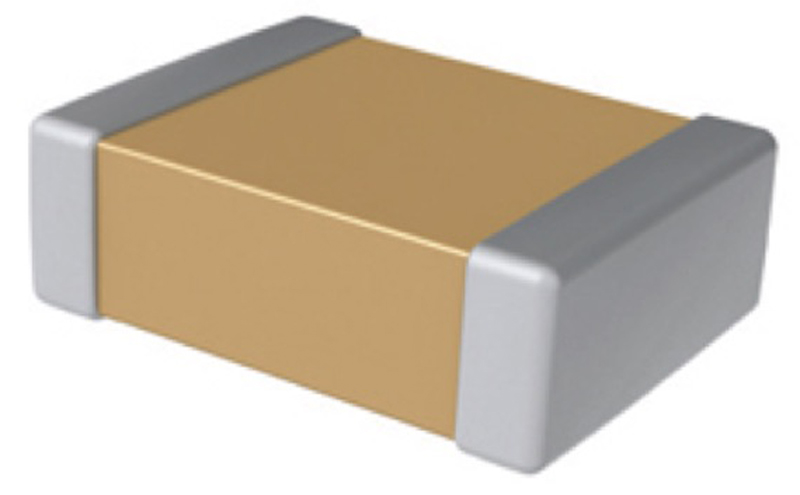
Capacitors containing this U2J dielectric (see Figure 1) deliver about twice the capacitance of C0G devices within comparable case sizes. In the past, engineers would need to consider devices with class II dielectric to obtain capacitance above the typical C0G range in a small-footprint, low-profile package.
Click image to enlarge
Figure 1. The latest U2J dielectric brings higher capacitance ranges to applications typically served by class I technology
On the other hand, the class II devices typically have a less predictable capacitance change with temperature, and can lose up to 95% of their nominal capacitance at rated voltage. In contrast, U2J devices have been shown to have a highly stable voltage characteristic, and to vary by less than ±120ppm of the nominal capacitance per °C over a wide temperature range from -55°C to +150°C. Hence the new U2J technology can be seen to combine the desirable characteristics of C0G and class 2 dielectrics. U2J dielectric is compatible with base-metal electrode technology.
Engineers can use U2J devices to design critical timing, tuning or filtering networks using small, low-cost MLCCs in preference to larger and more expensive alternatives. Some obvious applications include phase-locked loops (PLL) or data-acquisition front ends, particularly in circuits that are highly space constrained such as mobile radios or automotive Advanced Driver Assistance Systems (ADAS). These characteristics also lend themselves to use in remote sensors including wireless sensors, where minimal but predictable capacitance change over a wide temperature range is an advantage. In addition, low energy loss and minimal self-heating in pulse circuits help maximize efficiency, and enhance and simplify thermal management.
A new roadmap
U2J is a relatively new dielectric technology, which is close to the beginning of its development cycle. The roadmap for U2J device families, going forward, is set to progress to encompass devices with higher voltage ratings and approval to tough quality specifications such as automotive AEC-Q200 guidelines.
KEMET is currently working with leading automotive customers to take advantage of the enhanced properties of U2J, combined with proven FT-CAP flexible terminations for flex-crack prevention, resulting in devices that exceed the AEC-Q200 guidelines and so can be used in systems that require extremely high reliability.
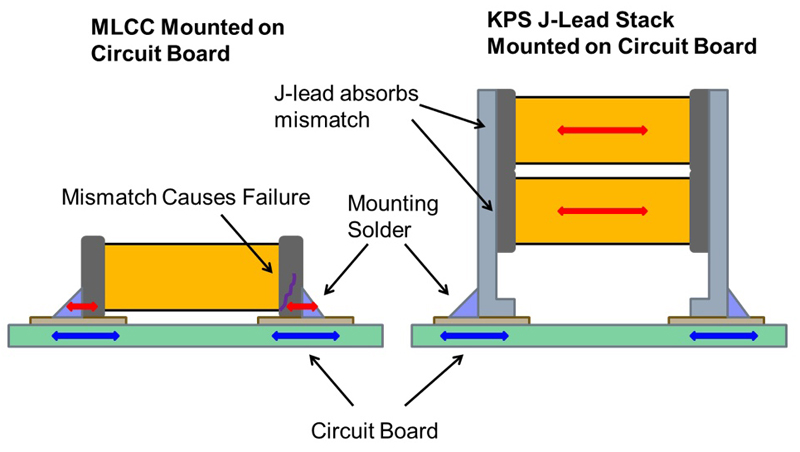
U2J capacitors can also be stacked to give even higher capacitance in a small board footprint. KEMET Power Solutions (KPS) proprietary leadframe technology with J-lead surface-mount contacts provides a robust termination system that mechanically isolates the MLCC terminals from stresses due to board flex and coefficient of thermal expansion (CTE) mismatch (see Figure 2). Current KPS stacked MLCCs in X7R (class II) dielectric are known to meet requirements for AEC-Q200 qualification. Stacked U2J capacitors will display equivalent mechanical reliability, combined with the enhanced electrical stability of the latest class I dielectric.
Click image to enlarge
Figure 2. U2J capacitors are compatible with proven stress-mitigation systems