The PARSTAT MC multi-channel potentiostat/galvanostat serves electrochemistry research and testing
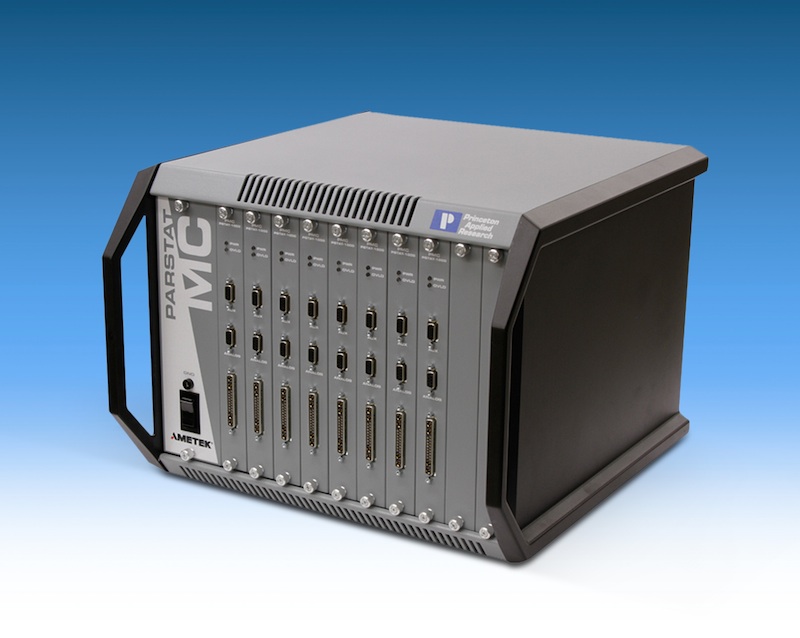
Princeton Applied Research of AMETEK Advanced Measurement Technology (AMT) has introduced the PARSTAT MC multi-channel potentiostat/galvanostat for electrochemistry research and testing. The highly modular and robust multi-channel PARSTAT MC potentiostat/galvanostat offers a host of features and benefits that build on Princeton Applied Research's more than 50+ years of industry leadership. "The modularity of the new PARSTAT MC allows for increased performance and reliability over other multi-channel instruments," notes Ben Lease, Vice President and Business Unit Manager for AMETEK Scientific Instruments. "It boasts hot-swappable channels that allow researchers to add or remove a channel without interruption while running experiments, which would normally result in a loss of associated data." The PARSTAT MC is well suited for a variety of applications, including testing of energy storage devices, corrosion analysis and physical electrochemistry. It features the widest dynamic current range of 2 amps to 4 nA (120 fA resolution) as standard, eliminating the need for costly hardware add-ons that reduce channel capacity. The PARSTAT MC's 500 kS/sec data acquisition speed makes it suitable for high-speed applications. Its true floating ground makes testing of multiple samples in the same cell possible and permits researchers the ability to measure permanently grounded samples. The availability of easily integrated accessories affords researchers the option of creating a highly customized research tool. The PARSTAT MC chassis is highly configurable with up to eight potentiostats. Each potentiostat card provides wide functionality as standard. Each channel can operate simultaneously for high-throughput routines, asynchronously for different experiments on distinct cells, or in a complex matrix of multiple electrodes in a single-test environment. Users can add additional channels on site, even while other channels are in operation. Every component within the chassis is user replaceable, minimizing the impact of interruptions on experiments. Princeton Applied Research