TI FPD-Link III chipset streamlines video and data interface for megapixel driver-assist cameras
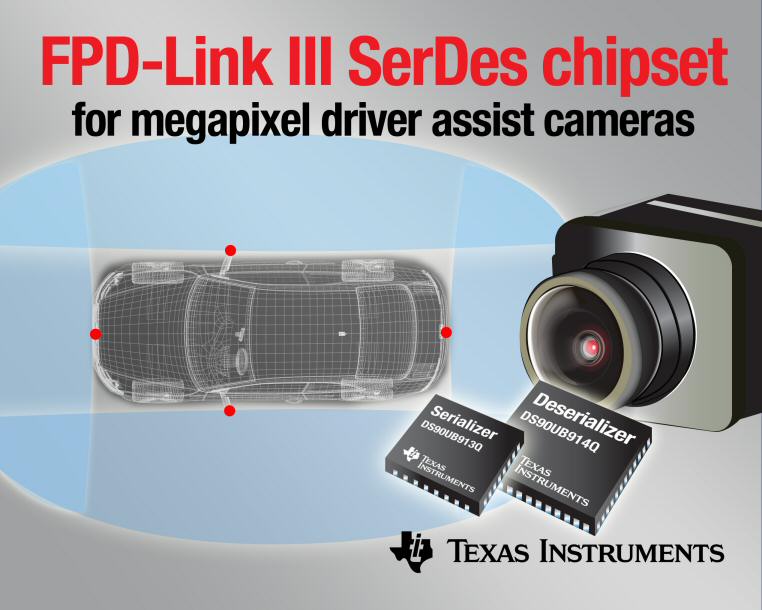
SerDes combines small footprint with system-level enhancements to drive camera safety systems into mid- and entry-level vehicles
DS90UB913Q serializer features a 10- to 100-MHz pixel clock and 10- and 12-bit pixel depth. The DS90UB914Q deserializer automatically adapts EQ gain, compensating for dynamic and long-term changes in cable loss.
Texas Instruments has introduced the DS90UB913Q serializer and DS90UB914Q deserializer, the newest additions to its FPD-Link III automotive-grade chipset family. The SerDes chipset provides a seamless video and data interface to megapixel driver-assist camera modules, with no software overhead and fewer wires, resulting in reduced power consumption, cost, and weight. These system-level SerDes enhancements are accelerating the adoption of camera safety systems in the mid- and entry-level vehicle segments. Applications include front-view camera for collision avoidance and traffic-sign and pedestrian recognition, rear-view camera for backup protection, and surround-view cameras for parking assistance. Camera systems have become an important automotive-safety component, typically combining multiple camera modules with advanced image analysis to help drivers monitor road conditions, detect hazards, and avoid collisions. Automotive safety-system designers can use TI's FPD-Link III SerDes chipsets to connect cameras and displays to an ECU (electronic control unit) with thinner, more flexible cabling. Key features and benefits of the DS90UB913Q and DS90UB914Q:
- Small serializer for ultra-compact megapixel camera modules: DS90UB913Q features 25-mm2 footprint, with 10- to 100-MHz pixel clock and 10- and 12-bit pixel depth.
- Adaptive receiver EQ compensates cable loss: DS90UB914Q automatically adapts EQ gain, compensating for dynamic and long-term changes in cable loss.
- Fast response time increases driver safety: Continuous, bidirectional control channel on a single twisted pair cable provides low latency for precise multi-camera synchronization.
- System flexibility: DS90UB914Q's integrated 2:1 multiplexer allows the ECU video processor to select content from two camera sources.
- Supports heat-exposed installations: The SerDes chipset operates from -40 to 105 °C.
The DS90UB913Q and DS90UB914Q can be combined with other automotive vision control building blocks, including the TMS320DM8148 (DM8148) automotive vision processor, LM22671 42-V, 500-mA step-down voltage regulator, and LP38693 500-mA LDO regulator. Tools and support The DS90UB913Q serializer and DS90UB914Q deserializer are supported by the SERDESUB-913ROS evaluation kit. It is available today for a suggested retail price of US$399. IBIS models for the DS90UB913Q and DS90UB914Q are also available. Availability, packaging and pricing The DS90UB913Q and DS90UB914Q are available now for a suggested retail price of US$5.36 (1000). The DS90UB913Q serializer is supplied in a 32-pin, 5 x 5-mm QFN package, while the DS90UB914Q deserializer is offered in a 48-pin, 7 x 7-mm QFN package. Texas Instruments DS90UB913Q serializer product deeplink DS90UB914Q deserializer product deeplink Automotive vision control-system interactive block diagram


.jpeg)
 Single.jpeg)


