Cordless, battery-operated tools have evolved from a convenience for the home and garden hobbyist to a productivity driver for professionals.
From compact 12V drills to beefy 80V outdoor equipment, today’s tradespeople are looking for mobility, performance and operational flexibility. The proliferation of higher-voltage power tools creates challenges for battery manufacturers that quickly spill into the area of motor control. Here, engineers must design for power efficiency, rapid torque response, thermal management, circuit protection, compactness and harsh operating environments that include vibration, dust and wide operating temperature ranges.
For inspiration, designers can look to the automotive industry’s adoption of 48V power systems for mild-hybrid vehicles and electric subsystems, which offers a model for tool manufacturers by demonstrating how higher voltages can unlock greater power density, better cooling and system scalability. By transitioning power tools from conventional 18V and 24V battery platforms, tool designers can reduce current draw for the same power level, enabling thinner wiring while increasing power output to support more robust motors. Users, in turn, enjoy greater torque, faster charging, extended runtimes and better ergonomics – key performance metrics for professional-grade equipment.
As voltages climb and enclosures shrink, control silicon must deliver higher performance, stronger protection and simpler platforms that can be reused across entire product lines. In this article, we’ll outline key motor control trends and design challenges and share a practical check list for tool makers to consider when embarking on their next design.
Rationalizing a Fragmented Tools Landscape
Professional-grade tools support a wide range of duty cycles and power levels – high-speed cutting, high-torque fastening and long-duration landscaping – all subject to tight size, cost and reliability constraints. Historically, that fragmented environment demanded multiple discrete platforms, each with its own microcontrollers, gate drivers, sensing front-ends, firmware, validation and supply chain. Duplicative engineering and test and complex inventory management pushed up development costs. Multiple design and validation cycles triggered market delays. And product lines defined by different voltages and features made it difficult for manufacturers to scale across their portfolios.
What’s needed is a single, flexible platform that supports multiple voltage levels, power tiers and use cases without sacrificing performance, safety or convenience.
Click image to enlarge
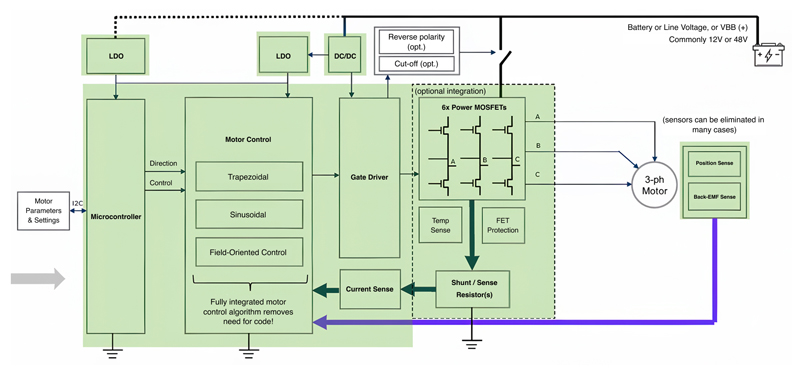
Figure 1: Flexible SoC solutions enable fully integrated motor drive systems that unlock advanced motor control capabilities without complex code
Trends Influencing Motor Control Designs
Manufacturers want one compact PCB design that scales across multiple SKUs to reduce bill of materials (BOM) and inventory carrying costs and simplify board layout to reduce test time, consolidate software resources and accelerate development cycles. That requires a single-chip control solution with a wide operating voltage and configurable power stage, so the same board can serve a 12-18V driver, a 36-40V angle grinder, a 56V mower or an 80V brushless chainsaw with minimal changes.
Integration and Advanced Software Rewrite Design Rules
A comprehensive system-on-chip configuration integrates the control logic, gate driver, current sensor front-end and pulse-width modulation (PWM) generator to cut costs, optimize board space and simplify assembly.
Intelligent software stacks further consolidate the BOM. While Hall-effect sensors still dominate many brushless battery-operated (BLDC) tools, algorithms like sensorless field-oriented control (FOC) and high-frequency injection (HFI) are replacing some sensors while enabling features such as soft start, stall detection and intelligent torque control to enhance safety and extend motor life. This requires ample processing power and memory to store and execute advanced motor control algorithms with minimal overhead.
Click image to enlarge
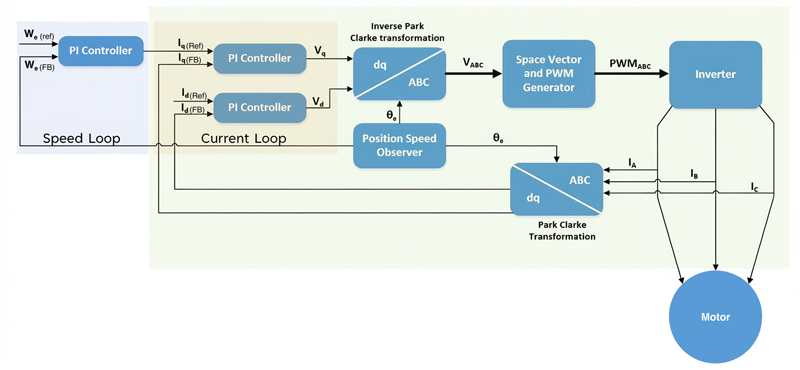
Figure 2: Algorithms like sensorless field-oriented control (FOC) generate sine wave currents that result in smoother operation and reduced electrical noise
Thermal Management with Field-Oriented Control Commutation
FOC is an advanced motor control algorithm used in BLDC motors to lower current usage. By transforming three-phase AC motor control into simpler DC-like control, FOC generates sine wave currents, unlike the block-based currents used by trapezoidal or six-step commutation methods. This results in smoother operation, which reduces mechanical "torque jerk" and electrical noise.
FOC commutation continuously adjusts power sent to the motor's windings to maintain maximum torque and efficiency, which helps eliminate waste energy that would otherwise become heat. In thermal management design, this prevents overheating by generating less heat internally, allowing for smaller heat sinks, better motor performance, longer lifespan and lower energy consumption.
Circuit Protection Looms Large at Higher Voltages
As systems move to 36-80V, switching edges are sharper and more punishing. This means that gate drivers and sensor front-ends must tolerate harsh electrical environments with negative transient protection down to -18V. Built-in protection minimizes the need for external components and is crucial for power tools, where large transient pulses are common when switching MOSFETs.
In that same vein, overtemperature protection (OTP) monitors the motor control’s junction temperature to avert potential damage to the part and surrounding components. Likewise, overcurrent protection (OCP) and overvoltage protection (OVP) prevent component failures and ensure safe operation by shielding the system from excessive current and voltage spikes, load dumps or other transient events.
Comprehensive circuity protection and onboard diagnostics not only monitor battery health and performance they’re a requirement for professional tools to safeguard the user against sudden equipment stall outs, blade jams and overheating.
What to Look for in a Modern Motor-Control Platform
Below is a checklist of capabilities matched to the trends above, with examples drawn from Allegro’s extensive experience designing motor-control circuitry for the power tool sector:
Portfolio Scalability: One platform spans compact hand tools to construction and lawn equipment on the same PCB.
Integration: Consolidated control logic, gate-drivers, PWM generators and current sensors save space/cost and simplify layout and validation.
Processing Headroom for Advanced Control: Sensorless controls like FOC and HFI algorithms and protection logic are designed with enough margin between PWM updates.
Flexible, Fast Current Sensing: Accurate, low-latency current feedback works across a broad range of tools and motors and is tunable for different current ranges.
Built-In Protections: Survives stalls, jams, and voltage spikes without external band-aids.
System Connectivity and I/O: Communicates with battery packs, triggers, displays, and accessories.
Software-Defined Tuning: Differentiates SKUs by firmware, not boards, while reusing hardware.
Payoff: From Fragmentation to a Single, Scalable Platform
Moving from fractured designs to a single SoC-based architecture can cut engineering and validation effort dramatically, reduce BOM and inventory costs and enable faster derivative launches. This kind of kind of motor-control “platform inside a chip” lets brands standardize hardware while differentiating in software.
In short, the trends is clear: higher voltages, compact housing, quieter and more efficient motors and faster product cycles. The solution is equally plain: integrated, protection-hardened, software-tunable motor-control SoCs that scale across the portfolio. That’s a recipe for enabling the next generation of high-voltage, professional-grade tools to run smarter, stronger and quieter – and get to market faster.