Date
03/08/2012
 PDF
PDF
Click image to enlarge
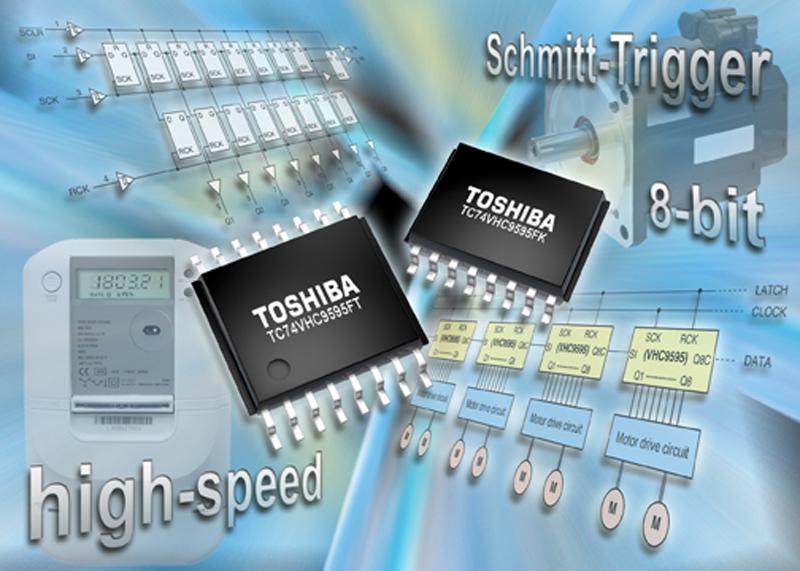
Toshiba Electronics Europe has launched a new shift register in the TC74VHC-logic series that can help engineers to reduce the number of external components required in cascaded connections. The new TC74VHC9595 8-bit shift register is ideal for signal control, serial-to-parallel conversion and other interfacing designs in applications ranging from office products and motor drives to factory automation equipment. The main feature of the TC74VHC9595 is an additional ‘Q8C' output port that can be directly connected to the ‘SI' input of the next TC74VHC9595 to enable cascaded operation without external components. Additionally, the TC74VHC9595 has an integrated Schmitt trigger on all input ports. This input allows operation with slowly changing or distorted input signals of the type that can occur on long transmission lines. The Schmitt trigger input also improves immunity against noise on signal and power supply lines. With integrated overvoltage protection the input side of the TC74VHC9595 can tolerate voltages up to 5.5V even when the power supply voltage is off. Furthermore, this voltage tolerance on the input together with the wide supply voltage range from 2.0V to 5.5V can be used to provide level shifting between 5.0V and 3.0V systems. The new TC74VHC9595 is available in a standard 16-pin TSSOP package (TC74VHC9595FT) or in an ultra-miniature VSSOP16 format (TC74VHC9595FK) with just 50% of the footprint of the TSSOP. Minimum output currents are rated at ±8mA, while a maximum propagation delay time of just 9.3ns ensures high-speed operation. www.toshiba-components.com