Toshiba launches ARM Cortex-M3-based MCUs for motion and consumer apps
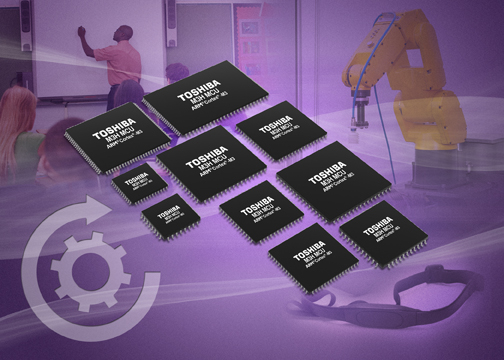
Toshiba Electronics Europe has announced a range of new microcontrollers (MCUs) based on the ARM Cortex-M3 core. The M3H microcontrollers are the first product group from the new TXZ Family and are the first Toshiba MCUs to be fabricated with an embedded flash memory process based on the 65nm logic process. Products in this group are well suited for use in a variety of consumer and industrial applications, such as motor control, consumer AV devices and office automation equipment.
The M3H group is based on the ARM Cortex-M core, the recognised standard for embedded 32-bit microprocessors, and incorporates high-performance analogue circuits and the wide range of basic functions required to support comprehensive motor control and consumer and industrial device applications. The line-up includes low-pin-count packages (32 to 100-pin) and small flash memory sizes (32 KB to 128 KB). The devices operate at up to 40Mhz.
Integrated features include a high-precision 12-bit A/D converter with a 1.5us conversion speed and an 8-bit D/A converter. The M3H group also features Toshiba’s programmable motor drive (PMD) that is suitable for inverter motor control, including A/C motor and BLDC motor control; and versatile general-purpose peripheral circuits including UART, I2C, TSPI, and timers. Incorporation of these highly precise analogue circuits and general-purpose peripheral circuits allows the M3H group to achieve low-power characteristics and high level functionality at the same time.
Samples of the 30 products in the M3H group of MCUs will start shipping in May 2016,
Toshiba Electronics Europe