Toshiba launches small LDO regulator ICs suitable for IoT applications
New devices combine low quiescent bias current, high ripple rejection and fast transient response
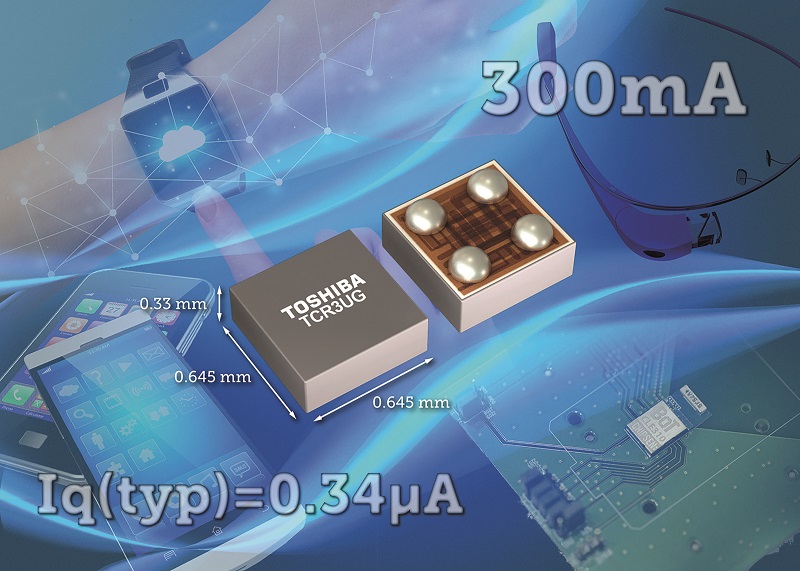
Toshiba Electronics Europe released the TCR3UG series of small package, low-dropout (LDO) regulators with an output current of 300mA, that are suitable for power management of IoT modules, wearable devices and smartphones.
Design engineers always need to consider the trade-off between the quiescent bias current, the ripple rejection ratio and load transient response of an LDO. While focussing on lowest quiescent current the TCR3UG series regulators offer the industry’s best trade-offs between these characteristics[1] by supporting excellent ripple rejection and transient response. They also deliver various protection features, including thermal shutdown, overcurrent protection and inrush current suppression.
Housed in the industry-leading small WCSP4F package, which measures 0.645mm x 0.645mm and a maximum thickness of only 0.33mm, the TCR3UG series helps to reduce the size and especially the thickness of mobile devices which is essential in some applications such as smart cards.
The devices have an input voltage range of 1.5 to 5.5V DC and exhibit a quiescent current of typically just 340nA. With this ultra-low quiescent current, they still offer an excellent ripple rejection ratio of 70dB and a load transient response of ±60mV.
The new LDO regulators are suitable for use as part of the power supply in applications that require long battery life, as well as applications that are susceptible to noise or fluctuations of the supply voltage. The TCR3UG-series is available with 31 output voltages, ranging from 0.8V to 5.0V. Additionally, variants with and without automatic output discharge are available, allowing designers to easily select the device that best meets the application's requirements.