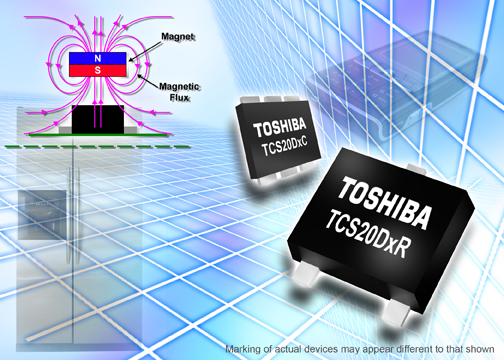
Toshiba Electronics Europe (TEE) has launched a new digital output magnetic sensor series that provides high sensitivity and low power operation in small surface mount packages. These new sensor ICs support demand for power saving in portable, battery operated equipment as well as home appliance or industrial applications where switching off individual functions contributes to higher overall system efficiency. The new TCS20Dxx series offers dual pole detection and comes in push-pull (TCS20DPx) or open drain (TCS20DLx) output configurations. The smallest package option is the ultra compact CST6C package (TCS20DxC). Measuring just 1.5mm x 1.15mm with a height of only 0.38mm, this version is ideal for non-contact switching applications such as open/close sensing in portable, battery-powered devices. As home appliance and industrial applications are typically less sensitive to board space requirements, Toshiba also offers the TCS20DxR devices in SOT-23F package options measuring 2.9mm x 2.4mm x 0.8mm. These Hall ICs have a maximum operating point (|BON|) magnetic flux density of 3.8mT and a minimum release point (|BOFF|) magnetic flux density of 0.3mT with a typical hysteresis (|BH|) rated at 1.4mT. These high levels of sensitivity allow the new devices to be used in conjunction with very small magnets. Toshiba's TCS20Dxx series operates from recommended supply voltages (VCC) between 2.3V and 3.6V and has a maximum supply voltage rating of 6V. Due to an internal circuit that realizes pulsed operation, an average current consumption as low as 7.3μA can be realized. www.toshiba-components.com