Trench MOS barrier Schottky rectifiers for smartphone and tablet chargers offer industry-low forward voltage
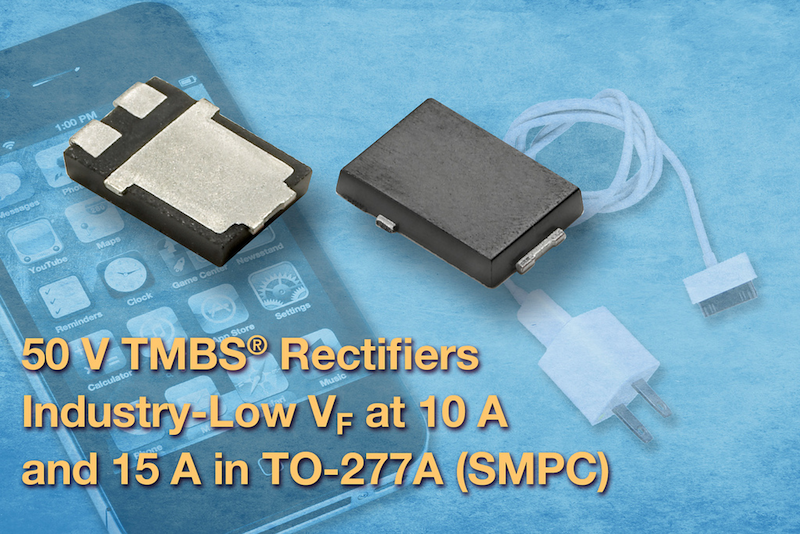
Vishay Intertechnology introduced two high current density 50 V TMBS® Trench MOS Barrier Schottky rectifiers. The V10PN50 and V15PN50 are the industry's first devices to combine low forward voltage drop down to 0.40 V typical at 10 A and 0.41 V typical at 15 A with optimized leakage current in the slim TO-277A (SMPC) package for smartphone and tablet charger applications. With their extremely low forward voltage drops and profile of only 1.1 mm, the new Vishay General Semiconductor V10PN50 and V15PN50 reduce power loss and improve efficiency in low-voltage, high-frequency DC/DC converters, freewheeling diodes, and polarity protection in space-constrained applications. The new rectifiers feature a maximum operation junction temperature of +150 °C and an MSL moisture sensitivity level of 1, per J-STD-020, LF maximum peak of 260 °C. Ideal for automated placement, the devices are compliant to RoHS Directive 2011/65/EU and halogen-free according to JEDEC JS709A standards. Samples and production quantities of the new 50 V V10PN50 and V15PN50 TMBS rectifiers are available now, with lead times of 18 weeks for larger orders. Pricing for U.S. delivery begins at $0.30 per piece in quantities below 10,000. Vishay Intertechnology
 Single.jpeg)


