Tweezers of Sound can Pick Objects up Without Physical Contact
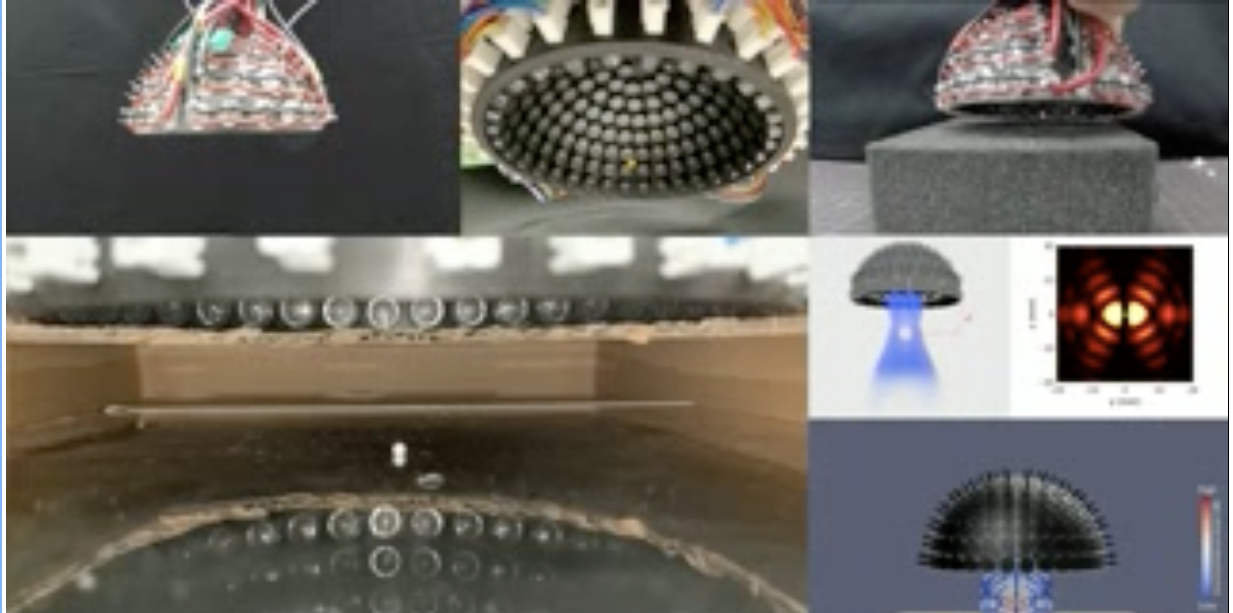
Hemispherical array of ultrasound transducers lifts objects off reflective surfaces
Researchers from Tokyo Metropolitan University have developed a new technology which allows non-contact manipulation of small objects using sound waves. They used a hemispherical array of ultrasound transducers to generate a 3D acoustic fields which stably trapped and lifted a small polystyrene ball from a reflective surface. Although their technique employs a method similar to laser trapping in biology, adaptable to a wider range of particle sizes and materials.
The ability to move objects without touching them might sound like magic, but in the world of biology and chemistry, technology known as optical trapping has been helping scientists use light to move microscopic objects around for many years. In fact, half of the 2018 Nobel Prize for Physics, awarded to Arthur Ashkin (1922-2020) was in recognition of the remarkable achievements of this technology. But the use of laser light is not without its failings, particularly the limits placed on the properties of the objects which can be moved.
Enter acoustic trapping, an alternative which uses sound instead of optical waves. Sound waves may be applied to a wider range of object sizes and materials, so much so that successful manipulation is possible for millimeter-sized particles. Though they haven't been around for as long as their optical counterparts, acoustic levitation and manipulation show exceptional promise for both lab settings and beyond. But the technical challenges that need to be surmounted are big. In particular, it is not easy to individually and accurately control vast arrays of ultrasound transducers in real-time, and get the right sound fields to lift objects far from the transducers themselves, particularly near surfaces that reflect sound.
Now, Researcher Shota Kondo and Associate Professor Kan Okubo from Tokyo Metropolitan University have come up with a new approach to lift millimeter-sized objects off a reflective surface using a hemispherical array of transducers. Their method of driving the array does not involve complex addressing of individual elements. Instead, they split the array into manageable blocks and use an inverse filter that finds the best phase and amplitude to drive them to make a single trap at some distance from the transducers themselves. By adjusting how they drive the blocks over time, they can change the position of their target field and move the particle they have trapped. Their findings are supported by simulations of the 3D acoustic fields that are created by the arrays, and of course, by their experiments with a polystyrene ball, which speak for themselves (see the video).
Though challenges remain in keeping particles trapped and stable, this exciting new technology promises big advances towards transforming acoustic trapping from a scientific curiosity to a practical tool in the lab and in industry.
EurekAlert!, the online, global news service operated by AAAS, the science society: https://www.eurekalert.org/news-releases/923462