Ultra-Low Jitter XOs Meet Needs of Compact Applications
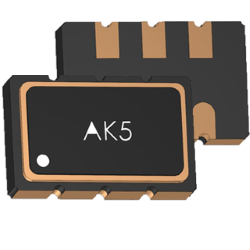
Abracon's new ultra-low jitter (sub-80 typ.) AK5 and AK7 ClearClock XO series are designed to meet the needs of compact applications such as optical modules, active cables and small networking and storage gear while maintaining the world’s highest data rates in excess of 10Gbps and up to 100/400Gbps.
Most network processors and advanced CPUs require ultra-low jitter for connectivity greater than 10Gigabits per second and up to 100Gbps. The AK5 (5.0 x 3.2mm) and AK7 (7.0 x 5.0mm) devices provide the best combination of ultra-low sub-80fs jitter performance in a small footprint. Typically consuming 30mW of power at the lowest operating voltage of 1.8V, the ClearClock™ line delivers industry-leading low power consumption for a low noise differential XO.
The AK5 and AK7 use a quieter third overtone architecture that avoids phase locked loop (PLL) based multiplication, reducing overall power consumption far below other high performance XO alternatives. For more information, read Abracon's newest application note, which reviews the third overtone solution and how it differs from the typical PLL-based architecture.
Key Benefits
- Exceptionally Low RMS Jitter: Sub-80fs Typ. (150fs Max @ 156.25MHz)
- Lowest power consumption in its class: 16mA Typ LVDS @ 156.25MHz
- ±20ppm & ±25ppm stability: Over industrial operating temperatrue (-40 to +85ºC)
- 3.3V, 2.5V, 1.8V supply voltage options
- LVPECL, LVDS, HCSL differential outputs
Applications
- PCI Express
- 10G/40G/100G Optical Ethernet
- Networking and Communication
- RF Systems & Base Stations (BTS)
- Data Centers
- Test and Measurement
For more information, visit https://abracon.com/.