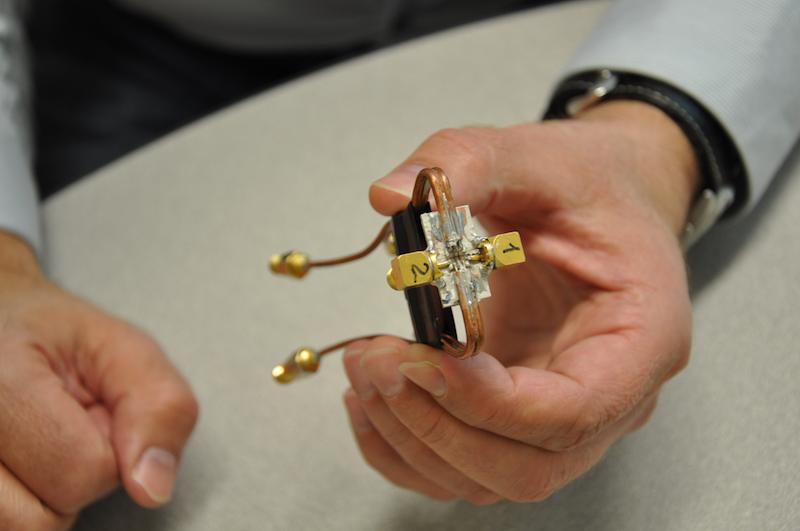
A team of researchers from the University of California, Riverside Bourns College of Engineering and Russian Academy of Science have demonstrated a new type of holographic memory device that could provide unprecedented data storage capacity and data processing capabilities in electronic devices.
The new type of memory device uses spin waves – a collective oscillation of spins in magnetic materials – instead of the optical beams. Spin waves are advantageous because spin wave devices are compatible with the conventional electronic devices and may operate at a much shorter wavelength than optical devices, allowing for smaller electronic devices that have greater storage capacity.
Experimental results obtained by the team show it is feasible to apply holographic techniques developed in optics to magnetic structures to create a magnonic holographic memory device. The research combines the advantages of the magnetic data storage with the wave-based information transfer.
“The results open a new field of research, which may have tremendous impact on the development of new logic and memory devices,” said Alexander Khitun, the lead researcher, who is a research professor at UC Riverside.
A paper, “Magnonic Holographic Memory,” that describes the finding has been submitted for publication in the journal Applied Physics Letters.