Versarien's advanced low-profile heatsinks suit space-constrained designs
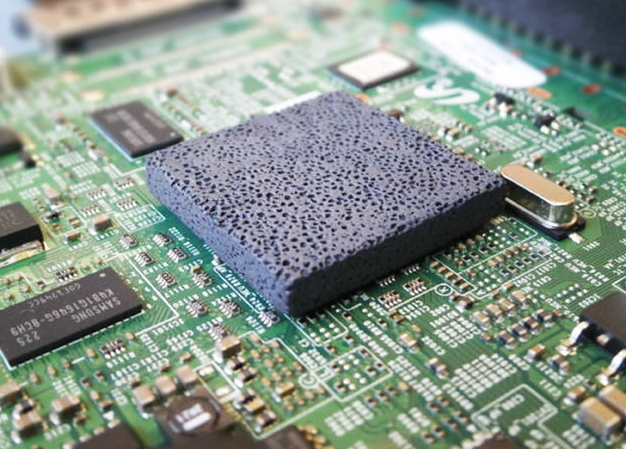
Versarien, an advanced engineering material group, has introduced a series of next-generation thermal management solutions optimized specifically for deployment in modern, streamlined, high-density electronic designs. Its new low-profile heatsinks utilize VersarienCu proprietary microporous copper technology to deliver industry-leading thermal performance for passive implementations at attractive price points.
Targeting set top boxes, flat panel displays, cable modems, broadband routers, Voice-over-IP (VoIP) equipment and Gigabit Passive Optical Network (GPON) communication infrastructure, LPH00xx series heatsinks are offered in form factors that cover 10mm x 10mm x 2mm through to 40mm x 40mm x 5mm.
VersarienCu has a multitude of interconnected pores distributed homogeneously throughout its base copper material. A thin but extremely hard high temperature copper oxide coating is then deposited on to it - enhancing the radiant properties of the heatsink, so that greater emissivity is realized. The result is that for any passive heatsink footprint it is possible to make a significant reduction in the required height without in any way compromising its capacity to remove heat generated by the sophisticated electronics it is in contact with - ensuring system reliability and safeguarding against operational failure.
Testing has shown that LPH00xx heatsinks can outperform comparable solutions by up to 6ºC/W. For an applied load of 5W the thermal resistance of a LPH0010 (40mm x 40mm x 5mm) heatsink is 17.4°C/W, while for a 2W load the thermal resistance of the LPH0004 (20mm x 20mm x 5mm) product is 35.8°C/W.
“Conventional passive heatsinks have to rely on use of micro-channels, fins or pins to increase their surface area, but this is not a particularly efficient approach, as it takes up a lot of space. It is therefore proving impractical for a growing number of application areas where available space is becoming extremely limited, or where a design has been carried out and then it becomes clear that adequate provision has not been made for thermal management,” states Neill Ricketts, CEO and Founder of Versarien. “The distinctive microporous structure of VersarienCu is far better at dissipating heat, with substantial increases in the overall surface area along with the conductive qualities of copper combining to deliver a compact cost-effective thermal transfer mechanism with elevated performance.”