Vishay FRED recovery rectifiers reduce losses in consumer products and electronic ballasts
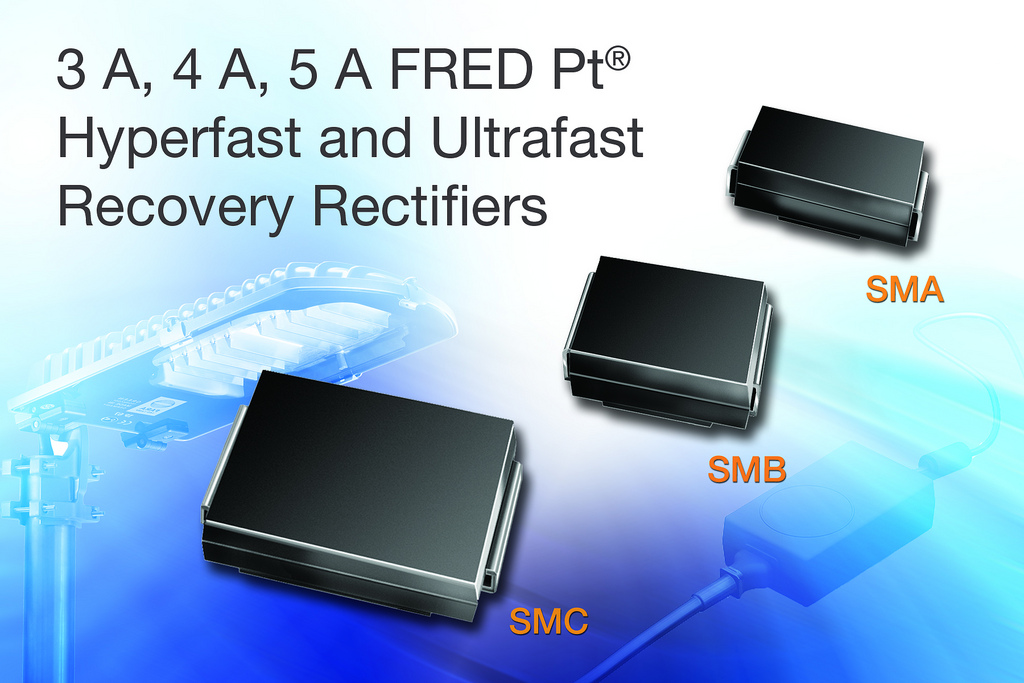
Vishay Intertechnology introduced 10 solderable FRED Pt® Hyperfast and Ultrafast recovery rectifiers that include the industry's first 3 A devices in the SMA package, 3 A and 4 A devices in the SMB package, and 4 A and 5 A devices in the SMC package. Combining extremely fast and soft recovery characteristics with low forward voltage drop and low leakage current, the new rectifiers reduce switching losses in consumer products, LCD TVs, power supplies, and electronic ballast lighting. The FRED Pt rectifiers released today offer designers a choice of current ratings, packages, and speeds to optimize efficiency in their applications. With forward currents up to 3 A in the SMA package, 4 A in the SMB package, and 5 A in the SMC package, the devices increase power density to facilitate lower system costs. "U Speed" Ultrafast rectifiers offer the advantage of lower forward voltage while "H Speed" Hyperfast devices provide a lower reverse recovery charge. The FRED Pt rectifiers are intended for power factor correction (PFC) diodes, boost diodes for discontinuous conduction mode (DCM) and critical conduction mode (CRM), and freewheeling diodes in power switching applications. The devices feature a planar structure and platinum doped lifetime control to guarantee high overall performance, ruggedness, and reliability characteristics. The components offer an operating junction temperature to +175 °C for a more robust design. The devices offer an MSL moisture level of 1 per J-STD-020, LF maximum peak of +260 °C, and they are RoHS-compliant and halogen-free. Vishay