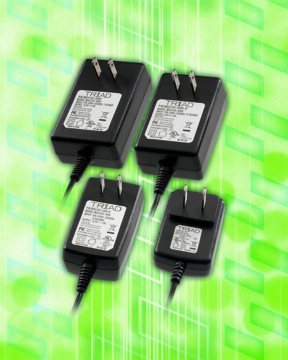
Designed with the latest switching topologies, the new WSU Series Wall Mount Plug-In Power Supply Series from Triad Magnetics meet or exceed U.S. EISA 2007, European CEC 2005/32/EC standards and California Electrical Commission (CEC) requirements, consuming 25% less power than previous generation power supplies. Their SMT design enables a reduction in package size of 50% and weight by 70%. Available in capacities from 6.75 to 36 W, the power supplies have an input range from 100 to 240 Vac, at 50-60 Hz with output voltages from 4.5 to 24 Volts. The six-foot long cord with standard barrel connector adds to the flexibility of the product. WSU Series Wall Mount Plug-In Power Supplies feature a dielectric strength of 4 KVdc for 60 seconds. Their rugged, double-insulated construction allows for operation from 0° to 40°C at maximum load. Operating from 5% to 95% non-condensing humidity, the RoHS-compliant power supplies also feature Class B EMI Certification, and meet the requirements of the European Union's Directive 2002/95 on hazardous substances including mercury, lead, hexavalent chromium, cadmium and a range of flame retardants. The WSU Series Wall Mount Plug-In Power Supplies are priced starting at $5.79 each with delivery from stock to 8 weeks lead time. Triad Magnetics