What's the Difference Between Traditional and Single Pair Ethernet?

See why the unique cable structure of Single Pair Ethernet make them ideal for hard-to-reach locations
Figure 1: Traditional RJ45 vs IEC 63171-1 SPE Connectors
What You’ll Learn
· Where to use traditional Ethernet cables versus SPE cables
· The differences in data flow and the maximum cable distance for traditional Ethernet and SPE cables
· Howtraditional Ethernet and SPE cables deal with crosstalk
· Exciting use cases where SPE shines
Computer networking with Ethernet cables that feature 8 wires arranged into 4 twisted pairs has long been the standard. The basic design is reliable and can handle the increased speed and bandwidth capabilities of Ethernet cables. Single Pair Ethernet (SPE) is a new solution for connecting Ethernet-enabled devices. Its unique cable structure makes SPE an excellent tool for introducing Ethernet to difficult to reach areas that have traditionally used other communication standards.
Location, Location, Location: Where to Use Traditional Cables versus SPE
Traditional Ethernet: When it comes to the high data rate needed for video streaming, large data transfers, and enterprise networking, the 4-pair twisted copper wires format is ideal. It’s also a great option for existing infrastructures like offices, homes, and data centers.
SPE: In locations where conventional enterprise networks don’t extend to, like the factory floor, SPE shines. When you need to connect existing machinery to the network in the industrial space, it’s a perfect option, especially as machines that still use industrial bus communications like Profinet and Fieldbus now require conversion to connect to the Ethernet network. This process is both complex and costly, making SPE a godsend solution.
It’s important to note that SPE isn’t intended to replace existing Ethernet equipment in the field. To replace the huge volume of cabling already deployed in existing infrastructure to support traditional Ethernet would be costly and time-consuming, with little overall benefit. Instead, SPE is designed to amplify this architecture by extending the existing Ethernet network. This results in a single network where each node is equipped with an SPE connector and given its own unique IP address to create seamless communication from the device to the cloud.
Single pair cables are smaller, lighter, and easier to manage than traditional Base-T network cabling. The small size of the two-pole connector delivers space-savings of more than 50 percent in both panel and printed circuit board (PCB) installations, making it easier to access hard-to-reach or restricted locations.
The Right Data for The Right Job: Traditional Ethernet versus Single Pair Performance
Traditional Ethernet: With the ability to reach beyond 10GB, and reliable up to a 100 meters channel length, traditional Ethernet cables are an easy choice for centralized, high-volume data flows. With decades of IEEE 802.3 standardization and well-understood design practices, traditional cables are also easy to plug into existing systems.
SPE: With equipment separated by considerable distances in remote installations, longer range is vital in today’s Ethernet applications. Additional routers and switches are needed to ensure secure communications in traditional Base-T networks over larger distances. This makes the greater range of SPE cables easier for connecting devices in dispersed installations.
The use of the single pair architecture does result in a compromise between high speed and long reach. Applications that require higher data rates, such as automotive and autonomous vehicles, do not require long cable lengths. These applications can take advantage of the high-speed specifications, such as IEEE802.3ch. In contrast, many long-distance applications in industrial and building automation do not require high data rates. They can make use of the 10Mbps performance of IEEE 802.3cg, which can extend up to 1,000 meters. (Compared to 100 meters for traditional cabling.)
It’s not only large devices that benefit. SPE can also provide power to small devices over the same pair of wires. Thanks to Power over Data Line (PoDL), designers don’t need to provide separate power connections. SPE can deliver up to 52 Watts of power over its single pair of wires, greatly simplifying the installation of remote devices.
Avoiding Interference: Crosstalk in Traditional Ethernet vs SPE
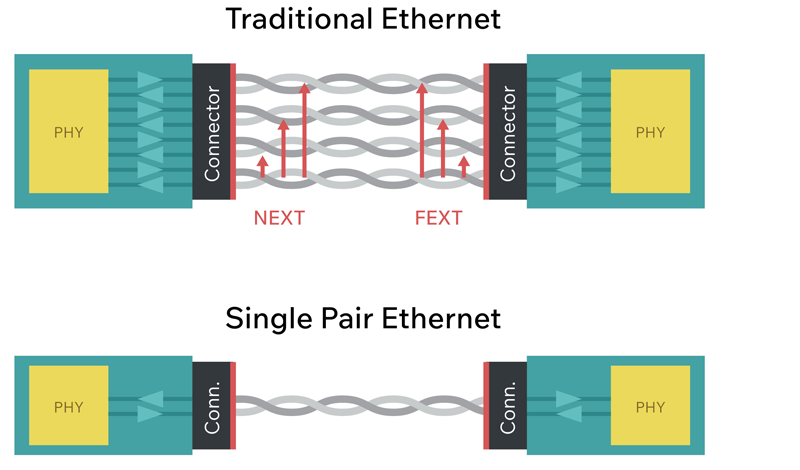
Crosstalk the term used when a signal traveling on one wire (or wire pair) in an Ethernet cable unintentionally interferes with a signal on another wire.
Traditional Ethernet: With multiple pairs of wire in the same cable there is an inherent risk of pair-to-pair crosstalk. This has been mitigated over the years with design techniques like carefully controlled twist rates per pair, physical separation and pair geometry, and different shielding options. And while standardized designed helps reduce crosstalk, it can still be a major design constraint, especially at high speeds like 10G or more. This is part of why traditional Ethernet cables are limited to the maximum length of a Base-T network cable.
SPE: Because they feature on one pair of wires, SPE cables are far less affected by crosstalk which allows them to provide transmissions over considerably longer distances. While they can be affected by External EMI and crosstalk between adjacent cables, this is reduced by operating on lower frequencies and designing cables with more robust physical layers (PHY).
Click image to enlarge
Figure 2: SPE Doesn’t Suffer from Cross Talk Interference from Adjacent Signal Pairs
Use Cases
Why SPE Cables Thrives in the Internet of Things
The benefits of Single Pair Ethernet in industrial settings are mirrored in a broad range of applications — many of which it was not originally designed for. SPE is an ideal solution for the Internet of Things (IoT), because the IoT relies on the constant transfer of large volumes of data created by small and relatively simple devices such as sensors. The compact size, light weight, and cost effectiveness of SPE are a perfect fit for small IoT-enabled devices.
The IoT brings together a huge range of sensors and devices into a Building Automation System (BAS). This type of system monitors all aspects of a building’s operations, so it must connect to many discrete devices — making SPE a hugely attractive solution for architects and installers. Its small size, ease of use, and extended transmission distances, combined with its ability to deliver power to a range of devices, make it ideal for BAS.
This benefit is especially integral in smart buildings because SPE makes it easy to interact with other IoT devices in the smart building via IP-based communication. Its bandwidth may be lower than Base-T cables, but it is more than enough for low-speed applications found within building automation, like monitoring and environmental control systems.
Why SPE is a Good Fit for Electronic Vehicles
SPE has attracted keen interest from the automotive industry because cable harnesses that deliver power, data, and more throughout the vehicle are complex and heavy. This complexity affects the manufacturing process, and the weight of cable harnesses significantly impacts vehicle performance. SPE can help dodge these issues.
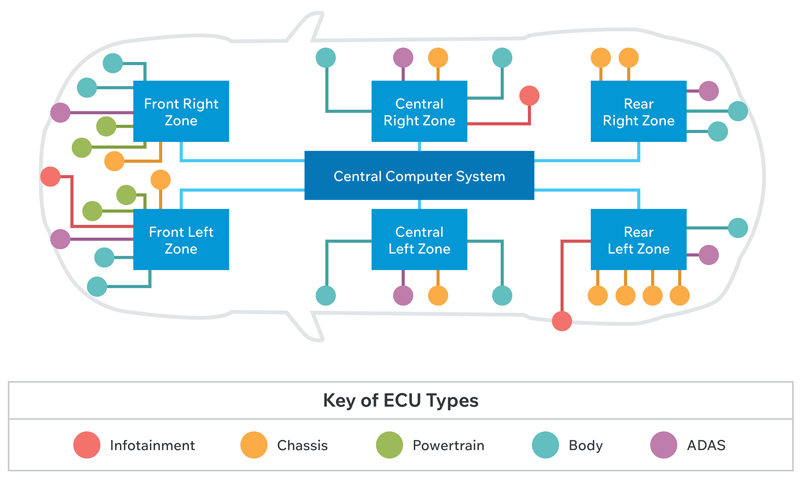
The automotive industry is turning to a new concept known as zonal architecture to address this growing challenge. In existing structures, systems are grouped together depending on their function, whereas zonal architecture divides the vehicle into locations (or zones). A controller responsible for all locally installed systems manages each zone. Because zonal controllers are close to the devices they manage, cable lengths remain short. This means the vehicle resembles a conventional network, as the zones are connected using Ethernet protocols.
SPE technology offers many advantages in this application by allowing devices to integrate with established automotive Ethernet technology while reducing weight and bulk. The smaller size of SPE cables and connectors decreases the size and weight of vehicle harnesses.
Click image to enlarge
Figure 3: Example of Zonal Architecture in an EV
While there are many advantages in more common networking situations for traditional Ethernet cables, Single Pair Ethernet cables are being rapidly adopted due to their small size, light weight, and easy installation. When it comes to industrial automation market and other applications that need cables that can go the distance, SPE is on the rise. It won’t replace traditional Base-T Ethernet, but it will enhance it — and take it to places previously off-limits.