Figure 1: An ADP1047 PFC stage with a downstream ADP1046 dc-to-dc converter
Voltage regulators usually serve the purpose of generating a constant regulated output voltage. By means of control loops, a stable and precise supply is generated from an unregulated input voltage. What purpose, then, does dynamic voltage scaling (DVS) serve?
Dynamic voltage scaling means that the output voltage of a power supply can be adjusted during operation. Such an adjustment can be made for various reasons.
Increasing the Conversion Efficiency of a PFC Stage in Light Load Operation
A power factor correction (PFC) stage for reactive power compensation takes the ac voltage of the grid voltage and increases it to adc intermediate circuit voltage. In 240Vac systems, this intermediate circuit voltage is typically 380V, as shown in Figure 1. The ADP1047 PFC controller can use DVS and lower the output voltage load dependently from the set 380V — for example, to 360V. This can increase the conversion efficiency of the power supply during operation at partial loads.
Efficient Operation of a Microcontroller in Various Operating States
Another example of DVS usage is shown in Figure 2. Here, an ADP2147 step-down switching regulator supplies a digital signal processor (DSP). In many applications, it is possible to increase the efficiency of a system with a microcontroller, DSP, or FPGA by reducing the core voltage when the processor is in standby mode. Numerous DSPs, including the ADSP-BF527 from Analog Devices, can be operated more efficiently when the VDD_INT voltage (core voltage) is reduced—for example, from 1.2V to 1.0V while the DSP is running in a condition with a low workload. The power dissipated by a processor is largely a function of its clock frequency and the square of the operating voltage. Reducing the supply voltage of the ADSP-BF527 by 25% reduces dynamic power dissipation by more than 40%. Many of Analog Devices’ DSPs behave in a similar fashion.

Click image to enlarge
Figure 2: An ADP2147 switching regulator with DVS for efficient operation of an ADSP-BF527
Improving the Recovery Speed Following Load Transients
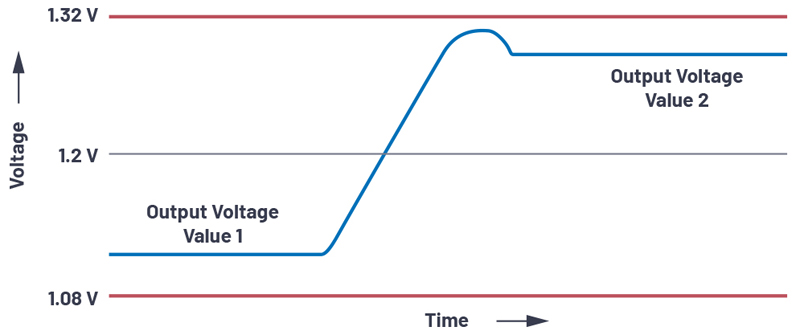
As shown in the previous two examples, a common reason for using DVS is to increase the efficiency or lower the losses. However, there are also other interesting applications. In many systems, a very precisely regulated supply voltage is necessary. Figure 3 shows a voltage range in which a core voltage of 1.2V is permissible. It could be 1.2V±10%. In this example, the voltage has to be maintained not only in the static load case, but also if the load changes dynamically. If the feedback control were to be set in the middle of the permissible range, half of the range would be available for static error sources and also dynamic voltage changes following load transients. A nice trick is to slightly increase the output voltage for a low load and slightly decrease it for a high load. In the high load case, it can be expected that a lower load will be applied at some point in time, usually with a small voltage overshoot. This is kept within the permissible range through slight lowering of the setpoint voltage for a high load, as shown in Figure 3. A high load is supplied on the left and a low load on the right.
Click image to enlarge
Figure 3: Dynamic adjustment of a supply voltage depending on the load current
The reverse case naturally works too. When the load is low, it can be expected to rise at some point in time. Then voltage undershoots could occur dynamically. The voltage is raised slightly at a low load so that they remain within the permissible range. One common term for this feature is automatic voltage positioning.
There are many further applications besides those presented here in which a dynamically changed voltage is beneficial. Some examples are controlling adc motor, operating an actuator, or driving a Peltier element for temperature regulation. Dynamic voltage scaling, that is, dynamic adjustment of a generated voltage, is helpful or even necessary in many applications. Especially in digitally controlled power supplies, DVS is commonplace and easy to implement.