Wind Forecasts Power up for Reliable Energy Production
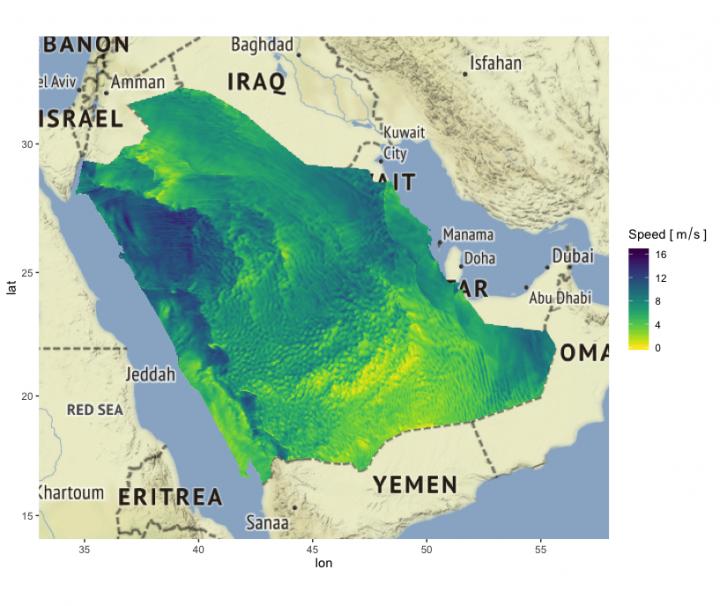
Optimizing the integration of wind energy into a country's power network requires reliable forecasts of how wind speed and direction are likely to vary in time and space over the pending few hours. KAUST researchers have now developed a statistical model that provides the best forecasts yet for wind conditions across Saudi Arabia.
"Saudi Arabia is aiming to diversify its energy mix and has set targets to significantly increase the amount of renewable energy in the grid, starting with wind and solar," says former KAUST postdoc Amanda Lenzi.
To reach the goal of 9 gigawatts of installed wind energy by 2030 requires reliable models and advanced forecasting methodologies for wind conditions across the kingdom. This will help underpin investment certainty and is also needed for the efficient integration of wind energy into existing power grids.
Using hourly observations from 28 wind stations across the country, Lenzi and group leader Marc Genton set out to develop a reliable forecasting model using advanced statistical approaches for dealing with environmental data.
"Our main innovation with this approach is the joint modeling of both wind speed and direction, which are normally treated individually," says Lenzi. "This approach shows improved prediction performance at time scales from a few minutes to hours ahead and from a single site to a whole continental area based only on a few wind monitoring stations."
Although wind is inherently variable, there is often a trend of stronger winds coming from certain directions. Relying solely on wind speed can therefore introduce a systematic error into wind energy forecasts. Lenzi and Genton addressed this by building a spatio-temporal model of wind speed using west-east and north-south directional components and an efficient representation of the space- and time-varying statistics to make the model computationally efficient.
"Using this approach, we are able to compute a full forecast distribution from just a few monitoring locations and construct maps of wind speed for all of Saudi Arabia at high spatial resolution for up to several hours ahead with minimal computational time," says Lenzi. "The model also provides an accurate measure of the uncertainty in these predictions, which is necessary for planning wind farms that operate at maximum efficiency."
Designed to be run using the latest wind data, the team expect that this model will aid in the efficient implementation of wind energy in Saudi Arabia.
EurekAlert!, the online, global news service operated by AAAS, the science society: https://www.eurekalert.org/pub_releases/2020-09/kauo-wfp092720.php