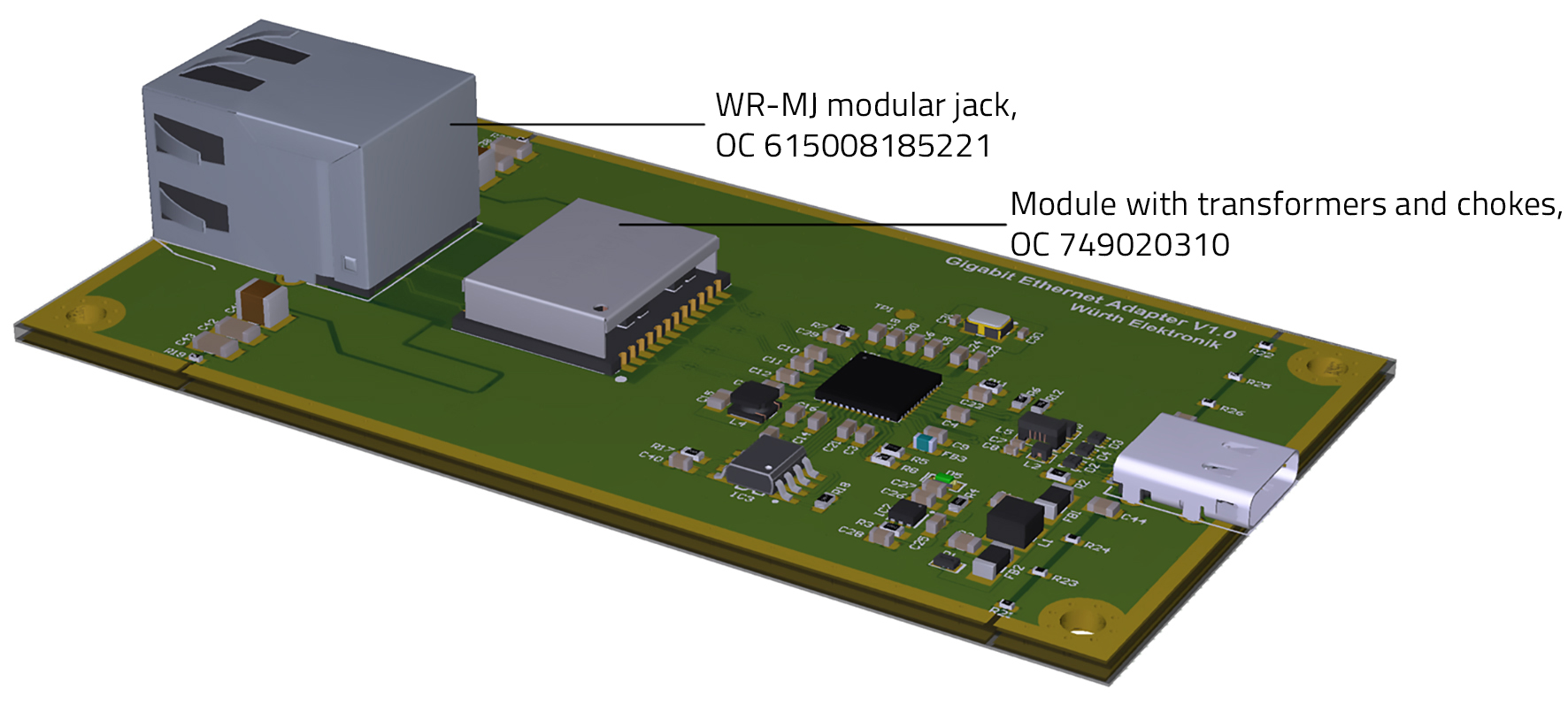
Würth Elektronik has published its RD016 reference design and the corresponding application note ANP116. With this, the manufacturer of electronic and electromechanical components provides valuable information for the development of EMC-compliant Gigabit Ethernet applications. Developers obtain an optimized circuit design and the best possible layout for their Gigabit Ethernet front end along with all technical data.
“Gigabit Ethernet has established itself as a networking standard in office and industrial environments. Nevertheless, there is little information in the relevant technical literature about EMC aspects of Gigabit Ethernet interfaces. We are closing this gap with our reference design,” says Gerhard Stelzer, Senior Technical Editor at Würth Elektronik eiSos.
The reference design offers two interfaces, a USB Type C (USB 3.1) and a 1 Gigabit RJ45/Ethernet interface. The Gigabit-Ethernet-USB adapter was developed based on the EVB-LAN7800LC evaluation board from Microchip. The circuit board uses a 4 layer stackup and is powered via USB. The first part of the document RD016 presents the technical basics necessary for understanding the reference design. The second part details the 1 GB Ethernet interface up to the physical layer (PHY in the OSI model). EMC aspects are covered in detail in App Note ANP116. Design data is available for reconstructing the reference board (Altium Designer / Gerber data).
Further information is available here.