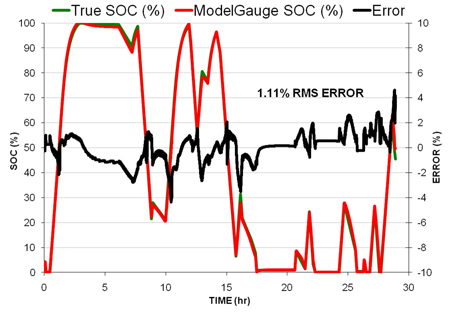
One of the most frustrating issues with portable electronic systems is turning the system on and finding that the battery is either dead or the system shuts down shortly after it is turned on. Although you could leave the system continually plugged in and charging when it is not in use, this can potentially reduce the life of the battery. What is needed is a form of fuel gauge, which is either built into the battery pack or into the system, to provide an accurate measure of how much charge is left in the battery. Although many products already include low-battery indicators, such displays rarely give any indication of how much usage time is available once the system turns on. Portable computers, smartphones, and other high-end portable products do include better fuel-gauging options and often include some power-management options to help minimize power consumption when the devices are active. However current-generation fuel-gauging techniques are not very accurate - typically delivering real-world results that are accurate to within only 10% to 30%. Such poor accuracy reduces the system's operating time since the gauge indicates that recharging is required a lot earlier than really needed. If, instead, the gauge was accurate to within a 5% or so, systems could run longer between charges, which would provide a better user experience. Additionally, the longer time between charges could reduce the cycling wear-out on the batteries, and thus let the batteries last a little longer as well. There are two primary methods to calculate the battery remaining capacity: one is voltage-based, while the other is coulomb-counter based fuel-gauging. A simple voltage-only fuel-gauging approach measures the battery's voltage based on the instantaneous voltage value. This is sometimes used in cell-phones and other applications which typically offer a "3 or 4 bar" battery indicator. The only hardware needed for the voltage-only approach is an ADC to read the battery's instantaneous voltage to demine the battery capacity. Although inexpensive, it is inaccurate because the battery voltage is not only a function of the state-of-charge (SOC), but also a function of the load, temperature, and age of the battery. Also, the voltage-based fuel-gauge inaccuracy is due to the flat voltage vs. SOC characteristic that most Li+ batteries exhibit, requiring a larger, heavier and bigger battery to provide the same run-time. The second approach to measure the battery's remaining capacity is to integrate the discharge-current measurements (i.e. coulomb counting) across a precision sense resistor. This method has the potential to predict the remaining capacity accurately, as long as appropriate compensation schemes are implemented to account for varying loads, temperature, and age of the battery. One concern about this method is the accumulation of the offset error while measuring current over time. This accumulated offset error causes the accuracy to worsen over time. Coulomb-counting algorithms must generally make their corrections during empty, full or system standby conditions leading to a more expensive bill-of-materials that requires a larger board area. So today, most cost-sensitive battery capacity measurement systems are based on voltage-based approaches. Maxim also supports voltage-based schemes, but goes one step further with a new algorithm that greatly improves accuracy. The newly-released MAX17040/MAX17041 and MAX17043/MAX17044 family of 1- and 2-cell fuel-gauge ICs employ a patent-pending algorithm, ModelGaugeTM, to estimate the Li+ battery state-of-charge. The new algorithm overcomes the limitations of other voltage-only fuel-gauging approaches by using a sophisticated battery-modeling scheme that delivers better accuracy than the other voltage-only solutions (see figure). The higher accuracy allows the system to run longer between recharge cycles, and that, in turn, could also extend the battery life since it would take longer to reach the maximum number of recharge cycles.
The fuel-gauge ICs also have the industry's lowest current consumption - just 50 μA, typical, which also helps extend the system run-time. The MAX17043/MAX17044 also include a programmable low-battery alert to warn the host system's microcontroller to take appropriate power management actions when the battery is nearly empty. Due to their simplicity and low active current, the ModelGauge-based ICs are a great match for wireless systems such as handsets, smartphones, e-books, portable games, portable navigation devices as well as digital cameras, blood glucose meters and many other portable products. These new ICs are the industry's only accurate fuel-gauge solutions that eliminate the current-sense resistor employed by the traditional coulomb-counting solutions. That reduces the number of components, saving both space and cost. ModelGauge ICs also eliminate the need for battery relearn cycles, as they do not require the system to reach empty, full or standby states required by typical coulomb-counting solutions. Additionally, the ICs can be mounted on the system-side instead of the battery pack. That lowers the battery-pack cost and allows designers to use batteries from more vendors. The ModelGauge ICs are shipped with factory calibration and that also helps simplify system manufacturing by eliminating calibration in the end-equipment manufacturing line. For systems that require even higher accuracy, Maxim is developing a family of fuel-gauge devices that incorporate both voltage measurement and coulomb-counting schemes. With this plethora of choices, it is easier and cheaper than ever for designers to make their products stand out by improving their system's usability by providing reliable battery indicators. www.maxim-ic.com

 copy.jpg)


