California Experiments with Adding Solar Panels to Canals
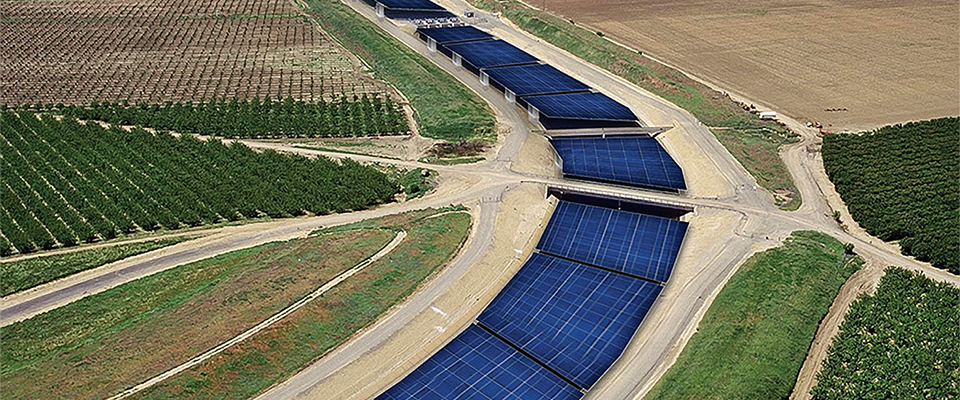
Synergy can be a wonderful, beautiful thing. And somehow combining state investment, local utility engagement, private sector innovation, and academic research is the unicorn of collaborative efforts.
California has a major issue with its waterways – apparently, 4,000 miles of irrigation canals lose 63 billion gallons of water each year to evaporation, the naturally dry conditions (and rising temperatures) are accelerating those losses.
And back in 2021, a team of scientists from UC Merced published a study suggesting that California could solve its canal conundrum by shading them with solar panels.
That would simultaneously reduce evaporation, cut down on weed growth, and of course, provide the state with clean, renewable energy.
Michael Kiparsky, director of Berkeley’s Wheeler Water Institute, noted that “With or without climate change, the supply of water in California is tightening, and the demand for water in California is increasing. And those two facts together mean that, indeed, any water savings is good, and it’s welcome.”
With that in mind, California has launched Project Nexus, currently underway in Merced County, which would test UC Merced’s theories on a microscale. The pilot site is 1,400 linear feet, and engineers are testing panels angled in both southern and western directions.
The project will apparently generate 1.3 gigawatt hours of electricity each year, but more importantly, it’ll alleviate many of the traditional fears and hangups associated with solar farms – that they’re eyesores, take up valuable real estate/farmland, and disturb the natural habitats.
If the project is successful, the implications could be enormous -- UC Merced estimated that covering all 4,000 miles of California’s canals could generate enough power for 2 million homes each year.
.jpg)

Accelerating Isolated Power Supply Design
05/10/2017