EVs and Hybrids Comprise Growing Percentage of Light Duty and Luxury Vehicle Sales
Alternative energy vehicles are making up a greater and greater proportion of the global fleet, and numbers released by the U.S. Energy Information Administration paint a pretty rosy picture of EV and hybrid adoption and our electrified future.
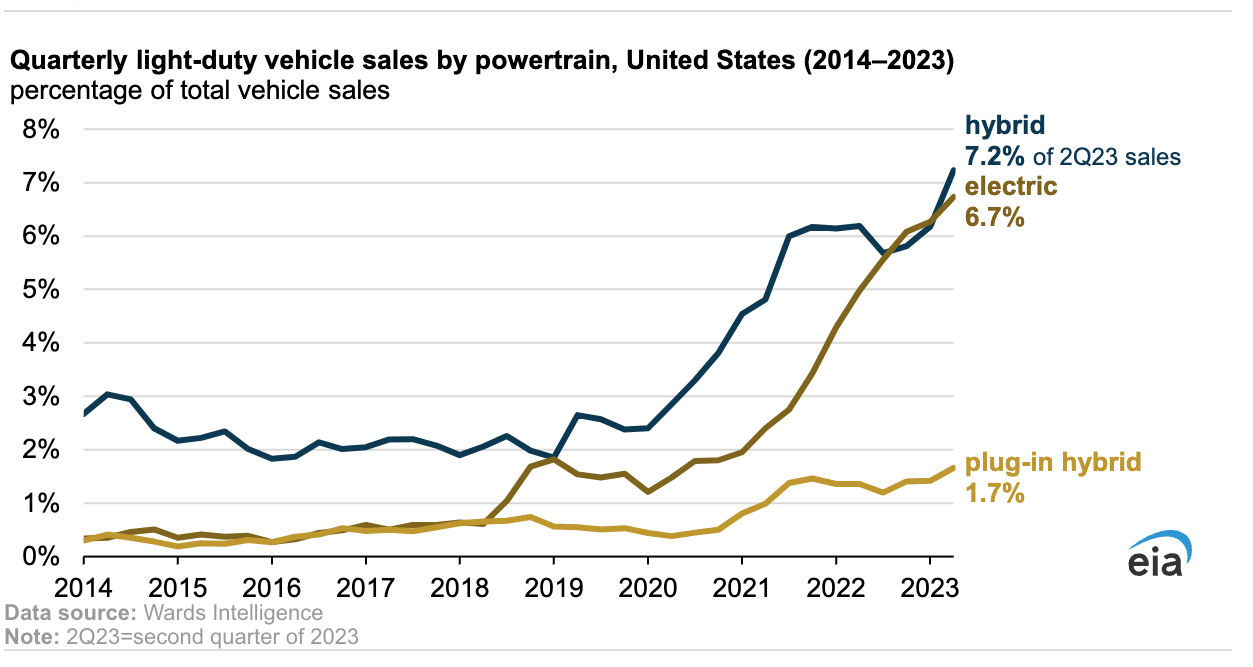
In 2Q 2023, hybrid, plug-in hybrid, and battery-electric vehicles comprised 16% of light-duty vehicle sales, with the EVs, in particular, spiking year-over-year.
While EV, hybrid, and plug-in growth was fairly anemic from 2014 through the end of 2019 (and hybrid sales actually decreased), they began a sharp upwards trajectory — possibly as a corollary effect of COVID, but more so tax breaks, rising gas prices, the steady march of technological progress, and a preponderance of other global, national, and socio-political factors.
And of course, there’s the fact that automakers are being incentivized (read: forced) to abandon the internal combustion engine in favor of more environmentally friendly (and expensive) options.
As a result, automakers have gotten proactive and set their own ICE phase-out dates.
According to the EIA, manufacturers reduced non-hybrid internal combustion engine (ICE) vehicle models from 318 to 297 between 2021 and 2Q23.
That’s one way to increase the percentage of EV, hybrid, and plug-in sales — reduce the alternatives.
During that same period, automakers increased the number of battery-electric models from 34 to 55.
Naturally, the percentage of EV, hybrid, and plug-ins in the luxury vehicle space was even higher, as EIA acknowledges that “Most of the shift toward battery-electric models is in the luxury segment.”
Indeed, manufacturers removed 17 luxury non-hybrid ICE vehicle models and added 19 luxury battery-electric models from 2021 and 2Q23, with battery-electric equaling a full 20% of new luxury vehicle sales.
Good to know that alternative energy vehicles are on the way up, even if some of the methods may have been a tad questionable.