Hybrid Diesel/Hydrogen Engine Could Reduce Emissions by 86%
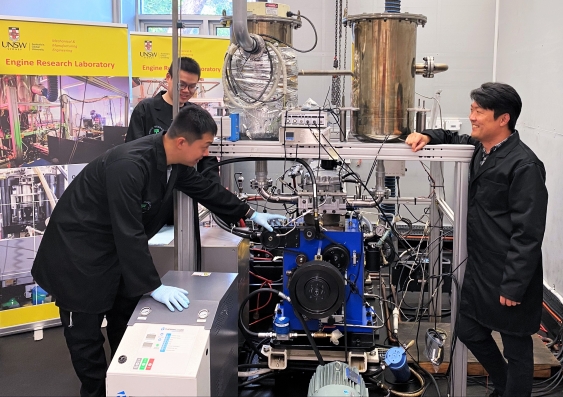
Electric vehicles are generally the cleanest, greenest transportation option, but they’re not always practical. And alternatives like hydrogen are often too expensive. Engineers at the University of New South Wales (UNSW) in Sydney may have found a middle ground.
The team at UNSW formulated a hybrid engine that runs on a mix of diesel and hydrogen, lowering emissions while maintaining many of the performance advantages of pure diesel.
By using a mix of 90% hydrogen, the researchers were able to reduce CO2 emissions to just 90 g/kWh, 85.9% lower than a pure diesel engine.
The hybrid engine utilizes “green hydrogen” – hydrogen obtained via renewable sources – and according to Prof. Kook, who led the research, “This new technology significantly reduces CO2 emissions from existing diesel engines, so it could play a big part in making our carbon footprint much smaller, especially in Australia with all our mining, agriculture and other heavy industries where diesel engines are widely used.”
Course, it’s not like industrial-strength EVs are a complete non-starter – on this page, we’ve covered Volvo Trucks’ numerous inroads (including an agreement with Amazon to provide 20 heavy-duty electric trucks), and the Hummer EV is already wildly popular (even if it’s not nearly as green as most would assume).
EVs will eventually infiltrate every industry, but for now, they often lack the power and performance required in applications like mining, long-distance transportation, power generation, and agriculture.
So while we wait for EVs to achieve full viability, we can lean on hybrid solutions like the UNSW’s, which allows pure diesel engines to be retrofitted quickly.
According to the UNSW press release, “any diesel engine used in trucks and power equipment in the transportation, agriculture and mining industries could ultimately be retrofitted to the new hybrid system in just a couple of months.”
And the most immediate application for this new technology could be “in industrial locations where permanent hydrogen fuel supply lines are already in place.”