Editor Blogs

    Is Nissan's New Solar Roof Too Ugly to Catch On?
    11/03/2025
    Jason Lomberg, North American Editor, PSD
    Tag: @nissan #solar #evs #psd #powerelectronics
    Is Nissan's New Solar Roof Too Ugly to Catch On?
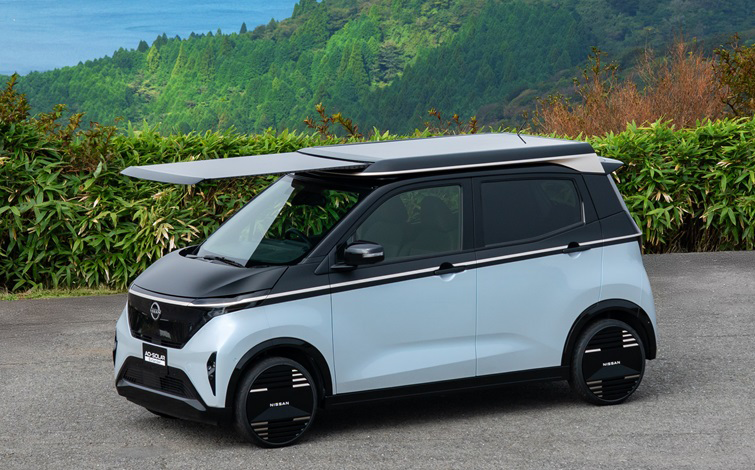
    The 'Ao-Solar Extender atop Japan's top-selling EV, the Nissan Sakura.

    ­Nissan has designed a solar roof for its Sakura "kei" EV that, like many renewable energy applications, might not pass the eye test.

    Let’s face it – a lot of solar power, wind, and a host of electric systems are technologically sound but a fugly eye sore. Wealthy homeowners are green zealots but often don’t want wind turbines obstructing their view of the coast. Photovoltaic solar panels are a great idea, but putting them atop residential roofs isn’t the most aesthetically-pleasing solution.

    And the less spoken about the ‘70s era EVs – i.e., glorified golf carts – the better.

    Nissan’s solar roof could end up falling into this category of elegant (and ugly) tech solutions.

    Of course, Nissan is pretty far from the first automaker to tinker with that idea. Companies up to and including Toyota – with its Prius – have tried to add a modicum of range with a solar roof.

    Nissan’s Ao-Solar Extender does what the name would suggest – when the car is in park, it expands outwards to provide a greater photovoltaic surface area and power generation potential to approximately 500 Watts. It also looks like a surfboard.

    Yes, it allegedly provides additional range of approximately 1,864 miles annually, though one wonders how much of that year would have to be spent in park. The company also touts the potential to block out sunlight and save on AC power consumption, though that seems spurious at best.

    But I’m not sure how many motorists want a surfboard permanently fused to their car’s roof – even if it’s retracted. And that’s literally on top of a vehicle that’s already winning no beauty contests.

    Whether it’s a top priority or not, renewable energy aesthetics do matter.

    Recent
    Battery Life: How Can We Get More from Each Charge?

    Battery Life: How Can We Get More from Each Charge?

    04/12/2017
    Meng He, Executive Business Manager, Core Product Group, Maxim Integrated
     Creating Smaller, More Efficient Isolated Power Supplies with Iso-Buck Converters

    Creating Smaller, More Efficient Isolated Power Supplies with Iso-Buck Converters

    04/17/2017
    Reno Rossetti, Principal Technical Writer, Maxim Integrated
    Accelerating Isolated Power Supply Design

    Accelerating Isolated Power Supply Design

    05/10/2017

    Reno Rossetti, PhD, EE, Maxim Integrated
    The Pope Receives his First Electric Car

    The Pope Receives his First Electric Car

    06/02/2017
    Jason Lomberg, Editor, North America, PSD

    Power Systems Design

    146 Charles Street
    Annapolis, Maryland 21401 USA

    Power Systems Design

    Power Systems Design is a leading global media platform serving the power electronics design engineering community. It delivers in-depth technical content, industry news, and product insights to engineers and decision-makers developing advanced power systems and technologies.

    Published 12× per year across North America and Europe, Power Systems Design is distributed through online and fully digital editions, complemented by eNewsletters, webinars, and multimedia content. The platform covers key areas including power conversion, semiconductors, renewable energy, automotive electrification, AI power systems, and industrial applications—supporting innovation across the global electronics industry.