Editor Blogs

    Organic Solar Cell Glasses Generate Power Indoors
    08/03/2017
    Jason Lomberg, Editor, North America, PSD
    Tag: #solarcell #photovoltaic @KITKarlsruhe #psd #technology
    Organic Solar Cell Glasses Generate Power Indoors

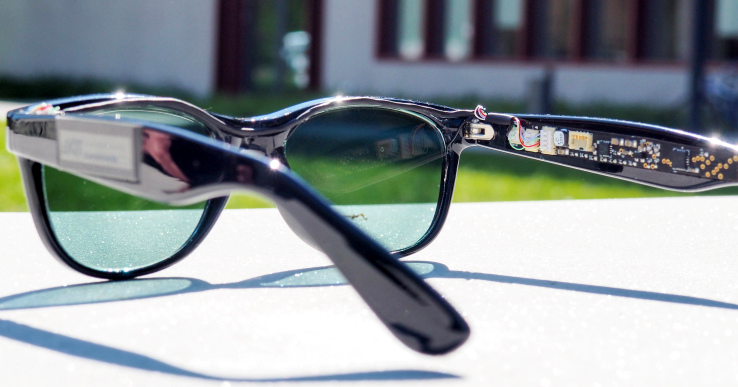
    How would you like a wearable device with heads-up display functionality that’s not half as dorky as Google Glasses? Well, the prototype Solar Glasses from the Karlsruhe Institute of Technology isn’t ready for public consumption, but it does prove that you can wear a nifty widget on your face without violating all norms of fashion and good taste. And they work indoors.

    The Solar Glasses use organic solar cell lenses to generate enough power to run small electronics (the prototype uses the excess juice to display the solar illumination intensity and ambient temperature). The lenses are 1.6 millimeters thick and weigh about six grams, making them a perfect fit for normal commercial frames.

    Why organic solar cells? According to KIT’s press release, “Organic solar cells are flexible, transparent, and light-weight – and can be manufactured in arbitrary shapes or colors. Thus, they are suitable for a variety of applications that cannot be realized with conventional silicon solar cells.”

    And the glasses can still function in less-than-optimal lighting conditions. The prototype can generate power indoors, under illumination down to 500 Lux.

    But the greater application has little to do with wearables, and it involves deploying organic solar cells on a large, industrial scale.

    “Since the glass facades of high-rise buildings must often be shaded, it is an obvious option to use organic solar modules for transforming the absorbed light into electric power,” according to the press release.

    “A future vision for the engineer, who works on the basic understanding of organic solar cell and semiconductor components at the Material Research Center for Energy Systems, is to coat large surfaces with organic solar cells using reel-to-reel technology.”

    Recent
    Battery Life: How Can We Get More from Each Charge?

    Battery Life: How Can We Get More from Each Charge?

    04/12/2017
    Meng He, Executive Business Manager, Core Product Group, Maxim Integrated
     Creating Smaller, More Efficient Isolated Power Supplies with Iso-Buck Converters

    Creating Smaller, More Efficient Isolated Power Supplies with Iso-Buck Converters

    04/17/2017
    Reno Rossetti, Principal Technical Writer, Maxim Integrated
    Accelerating Isolated Power Supply Design

    Accelerating Isolated Power Supply Design

    05/10/2017
    Reno Rossetti, PhD, EE, Maxim Integrated
    The Pope Receives his First Electric Car

    The Pope Receives his First Electric Car

    06/02/2017
    Jason Lomberg, Editor, North America, PSD

    Power Systems Design

    146 Charles Street
    Annapolis, Maryland 21401 USA

    Power Systems Design

    Power Systems Design is a leading global media platform serving the power electronics design engineering community. It delivers in-depth technical content, industry news, and product insights to engineers and decision-makers developing advanced power systems and technologies.

    Published 12× per year across North America and Europe, Power Systems Design is distributed through online and fully digital editions, complemented by eNewsletters, webinars, and multimedia content. The platform covers key areas including power conversion, semiconductors, renewable energy, automotive electrification, AI power systems, and industrial applications—supporting innovation across the global electronics industry.