Current Editor Blogs
    Robot Demo Features Realistic Eye Movements...with no Face
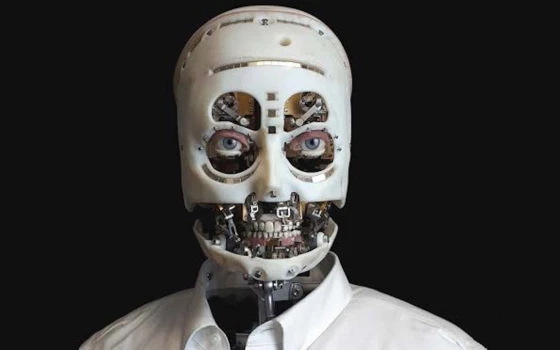
    Progress or uncanny valley? Or both?

    Robot Demo Features Realistic Eye Movements...with no Face

    11/03/2020
    Jason Lomberg, North American Editor, PSD
    Tag: @disney #robots #uncannyvalley #animatronic #psd #powerelectronics

    “In climbing toward the goal of making robots appear human, our affinity for them increases until we come to a valley, which I call the uncanny valley.” 

    - Masahiro Mori, robotics professor at the Tokyo Institute of Technology, 1970

    Disney Research’s latest robotics demo could be the first example of the uncanny valley where the subject has no face.

    To be more specific, Disney Research released a video with an animatronic bust demonstrating advanced, human-like eye movements. The hitch? The robot has no skin on his face. And yet…it’s familiar and more than a little disturbing.

    The animatronic demo is part of a Disney paper with the goal of creating a “lifelike gaze in human-robot interactions.”

    Disney theme park robots must have operators to “manually design and refine trajectories to create fluid motions,” and while, as the paper points out, this prevents those behaviors from descending into the uncanny valley, it “limits humanoid animatronics to performing non-interactive, scripted shows.”

    Disney’s roboticists chose to focus on the eye gaze because the “gaze has been shown to be a key social signal.”

    Their demo unit replicates "saccades," or rapid eye movement between multiple points, and the effect is striking – even with no skin on its face, the animatronic looks eerily lifelike.

    There’s a legitimate debate to be had as to whether adding skin would make the demo more or less creepy and possibly descend fully into the uncanny valley.

    Check out the demo here.

    Recent
    Battery Life: How Can We Get More from Each Charge?

    Battery Life: How Can We Get More from Each Charge?

    04/12/2017
    Meng He, Executive Business Manager, Core Product Group, Maxim Integrated
     Creating Smaller, More Efficient Isolated Power Supplies with Iso-Buck Converters

    Creating Smaller, More Efficient Isolated Power Supplies with Iso-Buck Converters

    04/17/2017
    Reno Rossetti, Principal Technical Writer, Maxim Integrated
    Accelerating Isolated Power Supply Design

    Accelerating Isolated Power Supply Design

    05/10/2017

    Reno Rossetti, PhD, EE, Maxim Integrated
    The Pope Receives his First Electric Car

    The Pope Receives his First Electric Car

    06/02/2017
    Jason Lomberg, Editor, North America, PSD

    Power Systems Design

    146 Charles Street
    Annapolis, Maryland 21401 USA

    Power Systems Design

    Power Systems Design is a leading global media platform serving the power electronics design engineering community. It delivers in-depth technical content, industry news, and product insights to engineers and decision-makers developing advanced power systems and technologies.

    Published 12× per year across North America and Europe, Power Systems Design is distributed through online and fully digital editions, complemented by eNewsletters, webinars, and multimedia content. The platform covers key areas including power conversion, semiconductors, renewable energy, automotive electrification, AI power systems, and industrial applications—supporting innovation across the global electronics industry.