Uber to Launch Air Taxi Service in 5-10 Years
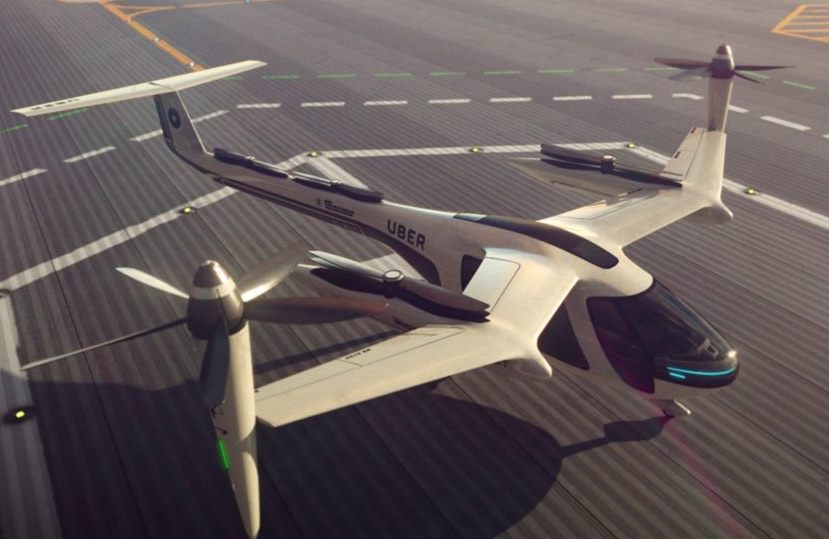
In the future, when you call an Uber, you might have to specify air or ground.
The peer-to-peer ridesharing company reaffirmed its commitment to an air taxi service that could proliferate globally in 5-10 years. By that point, “UberAir” (and a horde of competitors) could radically transform the notion of mass transportation.
Back in 2016, the firm released a 99-page whitepaper describing Uber Elevate, or "Fast-Forwarding to a Future of On-Demand Urban Air Transportation." The text posits a San Fran to San Jose trip in 15 minutes at the same cost as Uber X.
Impossible? Electrifying Uber’s airborne fleet will save big over gas, but the biggest efficiency gains will be seen in shorter, more direct routes.
“Trains, buses, and cars all funnel people from A to B along a limited number of dedicated routes, exposing travelers to serious delays in the event of a single interruption,” the paper notes. “VTOLs, by contrast, can travel toward their destination independently of any specific path, making route-based congestion less prevalent.”
That said, the more companies sign on to air taxi services, the closer we get to Back to the Future II’s airborne traffic jams, and with more low-altitude taxis taking off, the cost savings (as a result of less congestion) will vanish a tad. And the first air taxi fatality could ground entire fleets for weeks or months at a time.
Like every other air taxi service, UberAir will rely on Vertical Take-off and Landing (VTOL) aircraft, which essentially makes them akin to tiny helicopters, though conventional rotorcraft are “too noisy, inefficient, polluting, and expensive for mass-scale use” (not to mention, highly dangerous).
And the plans are rolling forward. Last November, Uber signed a Space Act Agreement with NASA to manage vehicles flying at low altitude, and the system will apparently be cheap(ish) and safe – the taxis will stay airborne if any single part fails.
Of course, full-scale air taxi deployment will be relatively slow, constrained by a lack of vertiport/vertistop infrastructure in cities and a dearth of qualified pilots – becoming a commercial pilot under FAR Part 135 requires 500 hours of pilot-in-command experience for VFR and 1200 hours for IFR.
Read more here: https://www.uber.com/elevate.pdf