Why Hasn't Wave Energy Taken off Like its Renewable Peers?
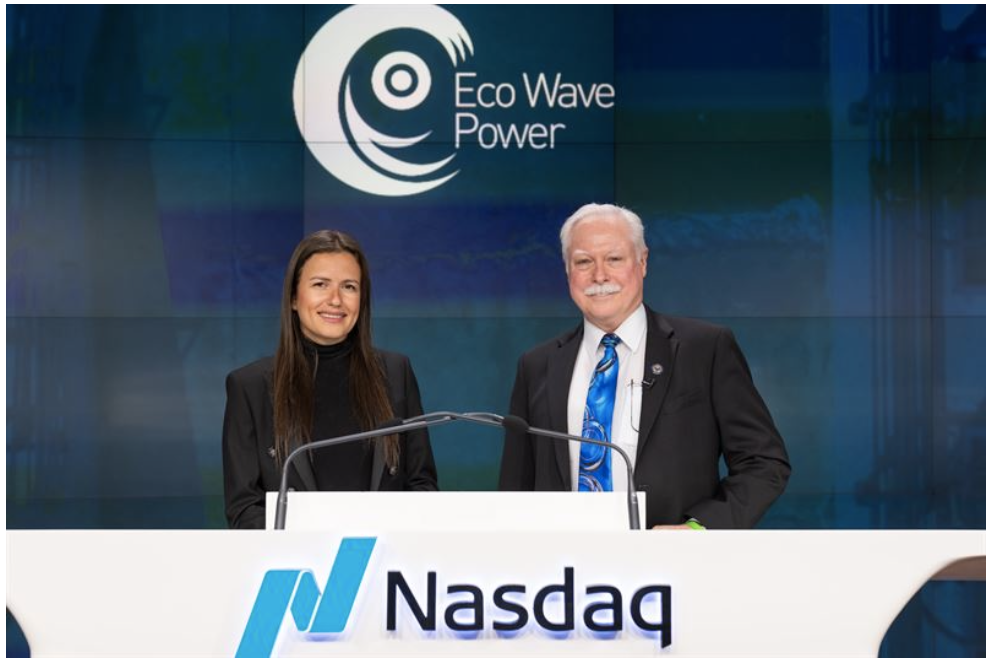
Eco Wave Power recently held its official bell ringing ceremony on the Nasdaq Stock Market to celebrate becoming a public company, rekindling the discussion on wave power. With the world rapidly embracing alternative forms of energy like solar and wind, it’s certainly worth revisiting something with as much raw power as the ocean.
It’s pretty far from a new concept, with the first known patent for wave energy dating all the way back to 1799, filed by French mathematician and engineer Pierre-Simon Girard.
And the potential is definitely there – the IEEE noted back in 2012 that while the power density of photovoltaic panels is 1 kW/m2 at peak solar insolation (and wind is 1 kW/m2 at 12 m/s) the average annual power density of the waves at e.g. San Francisco coast is 25 kW/m2.
It’s no stranger to this publication, either – on our PSDcast, we spotlighted C-Power, who, along with Vicor, helped develop a new version of their autonomous offshore power systems called SeaRay.
So why has wave energy struggled to take off when it has more untapped potential than its renewable peers?
A ZDNet article from back in 2014 pinpoints several issues shared by all renewable energy sources and at least one unique one.
According to Dave Levitan over at Yale Environment 360, part of the problem boils down to optimization.
“A recurring theme among wave power experts is that wave energy is where wind energy was three decades ago. At that time, engineers had not settled on the optimal design for wind turbines,” Dave said. “With wave power, some research occurred after the Arab oil embargo of the 1970s, but since then government and commercial research and development into wave power has paled compared to wind and solar energy.”
As with any “new” technology – or at least ones that haven’t established themselves in the mainstream – companies may be reluctant to invest before it’s proven itself.
In addition, the highly corrosive nature of the ocean and salt water presents unique challenges for any wave energy project.
But with that said, it’s still an area worth exploring, and for example, Assemblyman Robert Karabinchak of New Jersey, who attended Eco Wave Power’s Nasdaq ceremony, wants to promote wave energy in the Garden State.
In its press release, Eco Wave Power noted that Asm. Karabinchak plans to introduce new legislation initiative in this session to bolster wave energy as the next, up-and-coming renewable energy source.
“Our governor has laid out one of the most ambitious clean energy goals in the country - 35% by 2025 and 100% by 2050,” said Asm. Karabinchak. “Largely these goals will be met by offshore wind and solar, which I was proud to sponsor several pieces of enabling legislation. However, our renewable energy goals can only be met when all renewable sources work together, including wave energy.”
.jpg)
Accelerating Isolated Power Supply Design
05/10/2017