
Editor's note: Stackpole Electronics recently announced its 5 W ultra-precision current-sensing resistor—the CSS4527—available in values between 0.5 and 120 m? with tolerances to 0.5% and 50 ppm/°C TCR. Observing that these current-sense resistors offered no Kelvin terminals, Power Systems Design asked Director of Marketing Kory Schroeder if users needed to observe positioning tolerances or layout precautions to preserve the current-sense resistors' accuracy. He responded: Accurately measuring high currents using current sensing resistors can be challenging. Normally, high currents imply low resistance values to maintain efficiency. With these low resistance values comes the potential for voltage monitoring errors due to the effects of temperature. High currents also inherently translate to higher operating temperatures because of high-power loading and because the sensing circuit is typically in close proximity to the power devices it monitors.
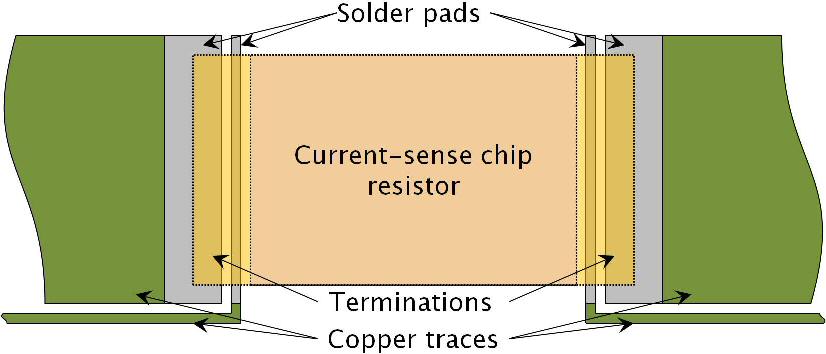
For applications less sensitive to temperature, it is usually sufficient to have high current traces going into the termination ends with sense leads running under the part connected inside of the terminations. However, this method is not adequate for resistance values below 3 m? or when the application requires a TCR less than 100 ppm/°C. For those applications, a four-terminal Kelvin connection can greatly improve the sensing accuracy, even if the resistor itself has only single terminations on each side (Figure 1). The solder pad layout that the figure depicts can improve the sensing accuracy by 20% to 50% over single pad layout designs. This design minimizes the effects of termination resistance and TCR by taking the voltage measurement as close as possible to the active area of the resistance element. The large current carrying traces have significantly less thermal influence on the separate sense leads running under the part. This type of layout has proven to be the most useful for high-current applications with demanding requirements for sensing accuracy. Stackpole Electronics

 copy.jpg)


