Grant supports mathematical modeling of biomass movement in large fermentation facilities
WEST LAFAYETTE, Ind. - Imagine trying to quickly turn a damp piece of plywood into a liquid and squeezing it through several small openings. That's essentially the challenge facing biorefineries trying to turn corn waste and related materials into ethanol fuel.
A big challenge in biomass processing, such as turning waste into ethanol fuel, is the difficulty in moving the biomass to, within and through the equipment needed to physically and chemically treat the biomass as part of the fuel production process.
Researchers at Purdue University have received $2.3 million in funding from the Department of Energy's Bioenergy Technologies Office for their work to create computer models to simplify the design and construction of biorefineries to help them better perform reliably, sustainably, safely and economically.
"We have basically used fundamental theories, particle properties, and measured bulk characteristics to develop and verify computational tools for biorefineries that are taking a material like corn stalks, sugar cane bagasse, or sawdust and making them flow like a liquid," said Michael Ladisch, Distinguished Professor of Agricultural and Biological Engineering at Purdue, who leads the research team and has been studying the topic of cellulose conversion and pretreatment for more than 25 years.
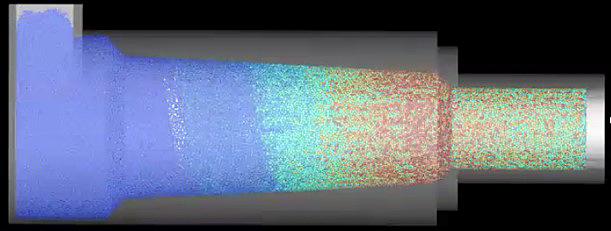
Ladisch said the team has created predictive analytical models that rigorously represent flow performance of biomass materials to define the conditions for robust operation and minimal downtime due to plugging problems from moving the materials within and between reactors.
Other members of the Purdue team include Carl Wassgren, a professor of mechanical engineering; Arezoo Ardekani, an associate professor of mechanical engineering; Pankaj Sharma, managing director of the Integrative Data Science Initiative; Eduardo Ximenes, a senior research scientist at Purdue's Laboratory of Renewable Resources Engineering; Kendra Erk, an associate professor of material engineering; Nathan Mosier, a professor of agricultural and biological engineering; and Kingsly Ambrose and Abigail Engelberth, both associate professors of agricultural and biological engineering.
The latest innovation and the predictive models come on top of other patented technologies created by the Purdue team and patented through the Purdue Research Foundation Office of Technology Commercialization. For more information on licensing the Purdue innovations, contact D.H.R. Sarma at the Office of Technology Commercialization at dhrsarma@prf.org.
The analytical models address on machinery and operating conditions developed at several locations, including Purdue, with the latest grant going to address techniques previously developed and patented at Purdue based on technology that avoids chemical agents in the production of ethanol fuel. A combination of water and enzymes are used to break down the waste materials into forms usable in the production of biofuels.
"We are a small piece of the bioenergy puzzle, but we believe our work is part of the larger progress to reduce carbon emissions and help farmers," Ladisch said.