Advancing EV Charging Infrastructure with 1700V SiC MOSFET Technology

High-voltage SiC devices enable more efficient, compact, and thermally robust charging systems for next-generation electric vehicles
Figure 1: Fast, consistent switching—under 110ns across temps—enables multi-MHz operation with minimal derating and reduced switching losses
With accelerating adoption of electric vehicles, the performance and scalability of charging infrastructure have become critical engineering priorities. Onboard chargers and off-board fast charging systems require components that deliver high efficiency, reliability, and thermal stability under demanding conditions.
This article examines how 1700V Silicon Carbide (SiC) MOSFETs are emerging as a key enabler of this evolution. With ultra-low on-resistance, low input capacitance for high-speed switching, and the ability to operate at junction temperatures up to +175°C, these devices provide significant advantages over traditional silicon-based solutions. High blocking voltage and robust TO-247 packaging make them well-suited for a wide range of high-power applications within EV charging and battery management systems.
As a result, 1700V SiC MOSFETs play a pivotal role in advancing the efficiency, reliability, and compactness of modern EV power electronics.
Switching Time and On-Resistance Curves
Switching time and on-resistance curves demonstrate why 1700V SiC MOSFETs are the preferred option for high-power and ultra-high efficiency situations.
Even at -50°C, turn-on and turn-off times are less than 40ns and 45ns, respectively (See Figure 1). Both on- and off-transitions remain under 110ns, with their switching penalties increasing by only about 1ns/°C as the temperature rises near 175°C. Thanks to this precise temperature-to-speed relationship, multi-MHz commutations are made possible with little derating, which also reduces switching losses.
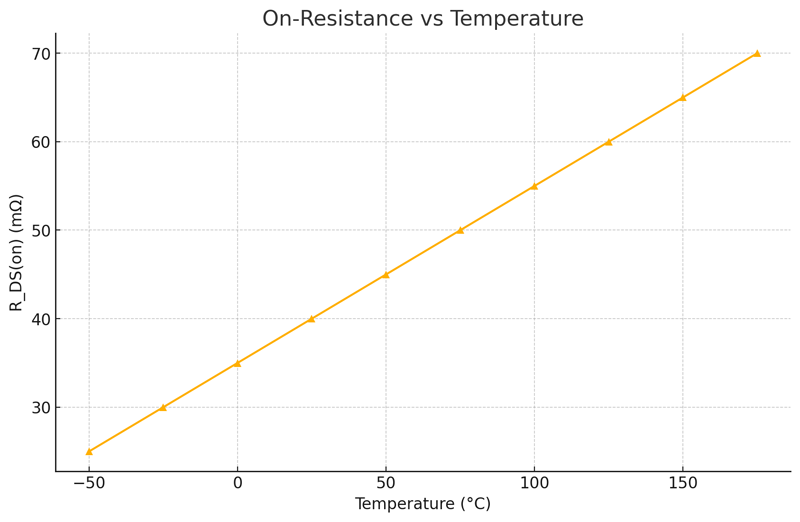
On-resistance increases from approximately 20mΩ at -50 °C to only about 80mΩ at 175°C, with a positive RDS(on) value of only 0.5%/°C. Practically speaking, your conduction losses barely rise even under intense junction heating, maintaining thermal headroom and system performance.(See Figure 2)
Click image to enlarge
Figure 2: Minimal RDS(on) rise—just 0.5%/°C—means conduction losses stay low even at 175°C, preserving thermal headroom and system efficiency
With their 1700V rating, these devices combine the best characteristics of SICs—low switching loss, low on-resistance, strong temperature independence, and enhanced breakdown field—to provide an excellent power component solution in a single package.
On-Board Chargers
On-board chargers in electric vehicles convert AC power from the grid into DC power to charge the battery (See Figure 3). With rising demand for higher power density and faster charging, 1700V Silicon Carbide (SiC) MOSFETs deliver critical performance improvements that enhance the efficiency and functionality of modern EV charging systems:
- Higher voltage tolerance: 1700V SiC MOSFETs enable greater bus voltages and tolerate large peak-to-peak swings, reducing current needs and resistive losses in power conversion stages. This allows for more compact designs and improved efficiency in high-voltage EV battery systems.
- Reduced switching losses: These devices can operate at faster switching frequencies without the high on-resistance, resulting in lower energy dissipation each cycle. This allows for smaller magnetics, resulting in a smaller, lighter, more affordable system.
- Enhanced thermal performance: The lower rDS(on) and high thermal conductivity of SiC MOSFETs minimize heat dissipation, reducing cooling system requirements and improving the overall reliability of on-board chargers.
- Topology considerations: In topologies such as dual-active bridge DC-DC converters and totem-pole power factor correction (PFC), SiC MOSFETs perform better than IGBTs due to their lower conduction losses, leading to increased efficiency under a range of load and temperature conditions.
Off-Board Fast Chargers
For ultra-rapid charging, off-board chargers—usually DC fast chargers with capacities between 50kW and 350kW or more—send high-voltage DC straight to the EV battery (see Figure 4). Using 1700V SiC MOSFETs enables higher power density in these systems, driving greater performance and efficiency. Key advantages include:
- Enabling multi-level converter architectures: Higher voltage tolerance allows for multi-level converter topologies, which improve efficiency, power handling, and reliability. Examples of these topologies include modular DC-DC converters and three-level NPC (Neutral Point Clamped) inverters.
- Higher switching frequencies: Smaller, more compact system design is achieved by reducing the size of passive components (such as transformers, inductors, and capacitors) due to the ability to switch at higher frequencies.
- Improved power density and thermal management: 1700V SiC MOSFETs lessen cooling requirements due to their increased thermal conductivity and reduced losses, making it easier to deploy rapid chargers in highway and urban infrastructure.
The future of electric mobility depends on EV manufacturers achieving greater energy efficiency, quicker charging speeds, and enhanced system dependability. Integrating 1700V SiC MOSFETs into both on-board and off-board charging solutions is key to enabling these advancements.

Click image to enlarge
Figure 3: A simplified representation of the on-board charger application blocks. The Totem-Pole PFC and DC-DC converter blocks can be enhanced using 1700V SiC MOSFETs
DC-DC Converters
A DC-DC converter is essential to electric vehicle (EV) power systems. It transforms high-voltage battery power into the lower voltage levels needed for auxiliary loads. For maximum powertrain efficiency, traction inverters rely on DC-DC converters to manage and stabilize voltage levels. Integrating 1700V SiC MOSFETs into DC-DC converters offers several key advantages:
- High voltage operation: Their ability to operate in battery designs exceeding 1000V increases efficiency and reduces voltage stress on components.
- Soft-switching topologies: These MOSFETs support ZVS (Zero-Voltage Switching) and ZCS (Zero-Current Switching) topologies, minimizing switching losses and boosting overall efficiency.
- Reduced conduction loss: Lower rDS(on) reduces conduction losses, resulting in less heat dissipation and improved thermal performance.
- Compact design: A more compact DC-DC converter can be built by increasing the operating frequency and reducing the size of the passive components.
Common DC-DC converter topologies utilizing 1700V SiC MOSFETs include:
- Isolated Resonant Converters (LLC & CLLC): These converters increase efficiency by using zero-voltage switching (ZVS) and zero-current switching (ZCS) techniques, which are made possible by SiC MOSFETs.
- Phase-Shifted Full-Bridge Converters: These 1700V SiC MOSFETs reduce dead time and switching losses, which lead to higher power densities.
- Bidirectional DC-DC Converters: SiC MOSFETs increase energy recovery efficiency in regenerative braking systems. DC-DC converters that use 1700V SiC MOSFETs are perfect for next-generation EV architectures because they are more reliable, smaller, and more efficient.

Click image to enlarge
Figure 4: A simplified representation of off-board fast charger application blocks. The Multi-Level Converter and High-Power DC Output stages can be enhanced with SiC MOSFETs
Traction Inverters
A traction inverter is the core of an electric vehicle's drivetrain, transforming DC battery power into AC electricity to operate the motor. A major innovation in this space is using 1700V SiC MOSFETs, which significantly impact the design of high-voltage electric drivetrains.
SiC MOSFETs support higher battery voltage compatibility, providing improved voltage headroom and enhanced system robustness for 1000V+ battery packs. They also deliver lower switching and conduction losses, which increases driving range and system efficiency by lowering energy dissipation.
High-Efficiency Inverter Topologies
SiC MOSFETs are used in three-level NPC (Neutral Point Clamped) inverters to enhance switching dynamics. These multi-level converters offer improved power quality and less torque ripple in electric motors. Traction inverters are used in electric cars, buses, and commercial vehicles. Integrating SiC MOSFETs will increase these designs' efficiency by 99 %, reduce weight, and extend operating ranges.
Conclusion
1700V SiC technology is true cutting-edge. Delivering exceptional performance in DC-DC converters, SiC MOSFETs enable decreased thermal losses, effective soft-switching topologies, and high-voltage operation. Similarly, their usage in traction provides high-voltage drivetrains with increased efficiency, driving range, and dependability.
These components are quickly becoming essential semiconductors for the next-generation EV architectures, allowing for quicker switching rates, reduced conduction losses, and enhanced voltage management in on-board and off-board chargers, DC-DC converters, and traction inverters. Manufacturers of EV charging architecture can increase efficiency and design flexibility by utilizing 1700V SiC MOSFETs, which will ultimately result in more potent, dependable, and energy-efficient electric vehicles.
.jpg)