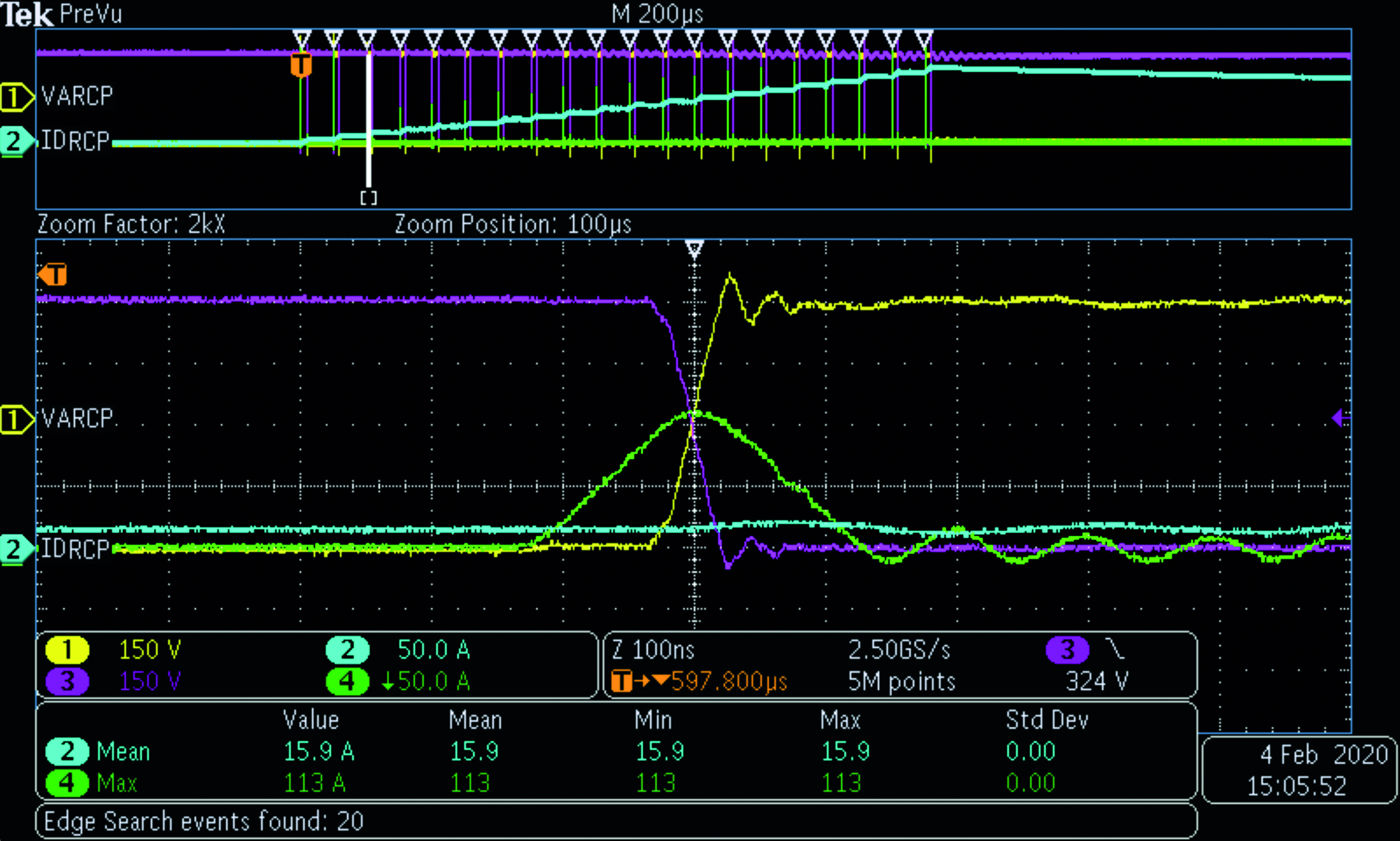
Screen captures illustrate active learning, analysis and adjustments that initiate and maintain optimized system timing
Pre-Switch, Inc., has released a demonstration and full explanation of its CleanWave200 inverter reference. An animated sequence of 20 1µs screen captures illustrates the Pre-Switch AI actively learning from initial start-up with unknown conditions, then subsequently optimizing and adjusting the timing necessary to ensure that a PWM input generates a current ramp to simulate the first part of a sine wave output.
Double pulse test data obtained from the 200kW inverter demonstrates that the Pre-Switch soft-switching platform - comprising the Pre-Drive 3 controller board powered by the Pre-Flex FPGA, and RPG gate driver board - reduces total system switching losses by 90% or more.
Upon commencement of the initial switching cycle (0), the Pre-Switch AI controller assesses multiple inputs to determine what mode the system is in, and then makes a safe but non-optimal estimate of the resonant period needed for soft switching. During the next switching cycle (1), all AI inputs and resulting outputs from switching cycle 0 are precisely re-measured and analyzed. A second conservative resonant timing period, similar to switching cycle 0, is issued.
In follow on switching cycle (2), the AI algorithm is now quantitatively-confident and able to predict the optimized resonant timing to ensure full soft-switching - thus minimizing losses in all aspects of the system. Then in switching cycle 3, the AI compares system inputs and results from previous switching cycles and adjusts the resonant timing to fully optimize soft-switching with the increasing load current. These inputs and outputs are stored with the previous switching cycle inputs and resulting resonant timings to improve accuracy and system optimization.
In subsequent cycles, soft switching accuracy continues to be optimized, stored to and compared to desired results necessary to maintain accurate forced resonance soft switching. Changes in system temperature, input voltage, output load current, and device degradation are all accounted for and optimized within the Pre-Switch AI algorithm.
For more information, click here.