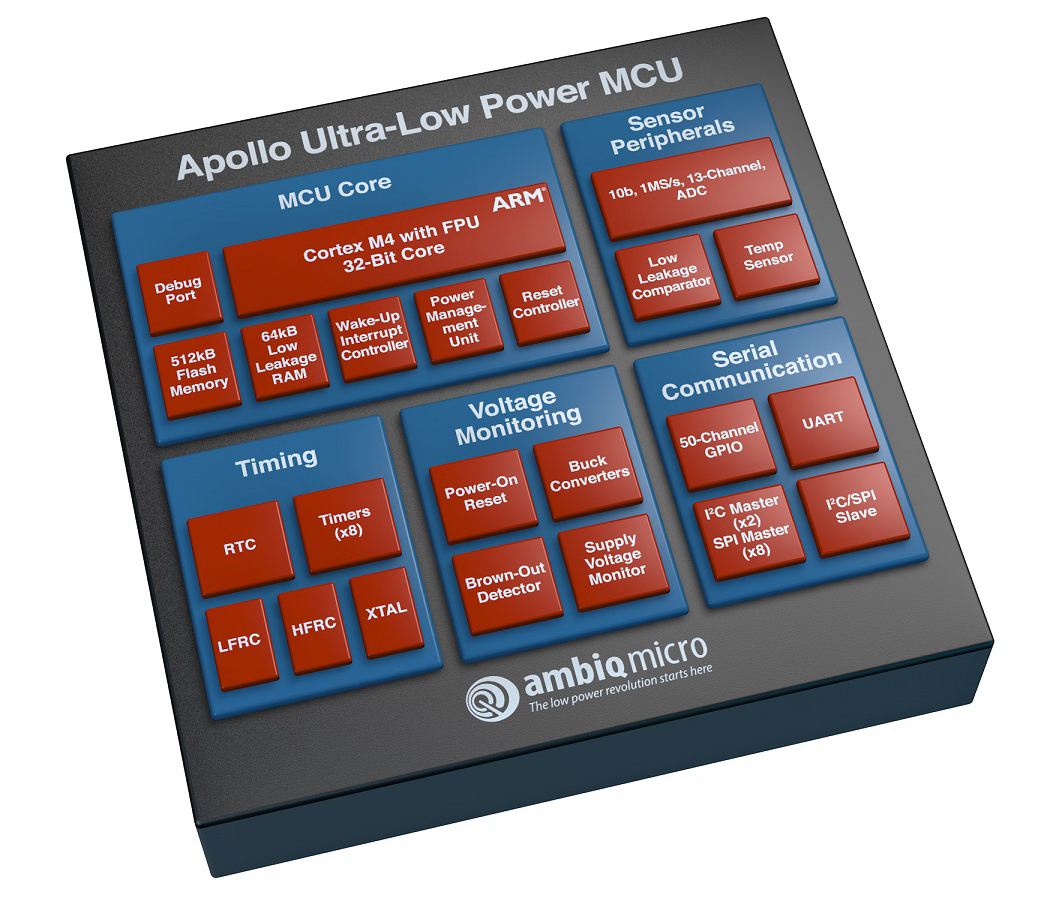
Ambiq Micro, the leader in ultra-low power solutions, today released the Apollo 2 Wearables and IoT Platform. The Platform offers breakthrough power consumption of under 10µA/MHz, which allows for double the battery life in wearable devices. Apollo 2's performance will lead to longer battery life, enhanced intelligence and improved functionality in wearables and IoT consumer electronics (CE) products. Ambiq Micro's Apollo 2 Platform provides dramatic reductions in energy consumption through its patented Subthreshold Power Optimized Technology (SPOT) technology.
"The incredible pace of Moore's Law disrupted computing every year or two and took us from room-sized supercomputers to billions of pocket-sized mobile phones," said Scott Hanson, founder and CTO, Ambiq Micro. "Ambiq Micro's SPOT technology will bring a similar pace of innovation to the IoT. As the foundation of our Apollo MCU, SPOT allows us to drive energy consumption below what we previously imagined was possible. With Apollo 2, we extend the SPOT technology to achieve new efficiencies for the next wave of IoT and connected devices."
Wearables and IoT devices need a longer battery life or smaller batteries to create slimmer and more fashionable form factors. To meet customer demands, devices must be always on, always connected and always aware. In order to provide that functionality without compromising battery life, devices will require lower power consumption standards. Ambiq Micro's Apollo 2 provides wearables and IoT device original equipment manufacturers (OEMs) a platform with a 5x reduction in power consumption, which leads to double the battery life of competitors.
"The market for wearables and IoT devices is growing rapidly, especially with younger generations accustomed to always-on and always-aware aesthetically designed devices enhancing their daily lives," said James Lee, President, Foxlink "This growth and stringent expectation mean chips powering our devices need to be faster and more efficient than ever. With Ambiq Micro's Apollo 2, we can offer some of the most feature-rich devices to consumers without sacrificing precious battery life or introducing unnecessary form factor constraints."
Ambiq Micro offers a wearables and IoT platform with ultra-low power consumption. A variety of major brands and OEMs are currently using Ambiq Micro's technology to build the most challenging low-power devices. The platform's low processing power consumption and large memory size give OEMs the ability to develop industry-leading devices replete with robust consumer applications.
Apollo 2's complete set of peripherals includes:
-High-precision 14-bit analog-to-digital converters (ADC)
-Digital microphone interface with pulse density modulation (PDM) for voice applications
-Voltage comparator
-Temperature sensor
-I2C/SPI for communication with sensors, radios, co-processor and other peripherals
-Universal asynchronous receiver/transmitter (UART) for communication with peripherals and legacy devices