Biobattery Could Help Everything Connect to the Internet
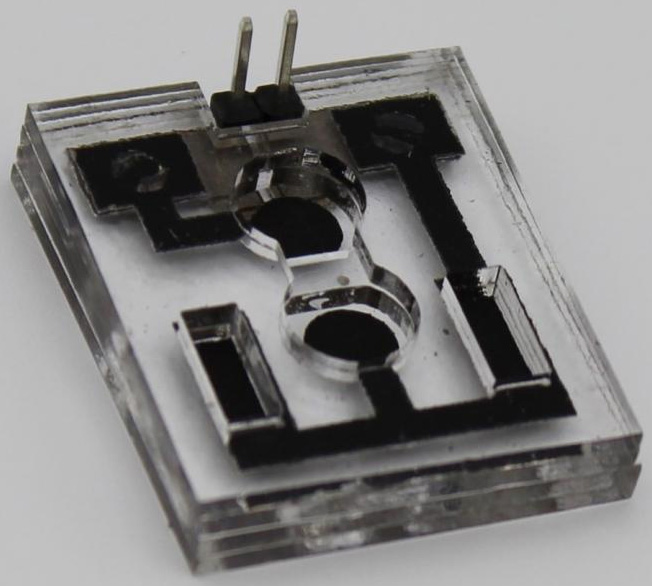
BINGHAMTON, N.Y. - In the future, small paper and plastic devices will be able to connect to the internet for a short duration, providing information on everything from healthcare to consumer products, before they are thrown away. Researchers at Binghamton University, State University of New York have developed a micro biobattery that could power these disposable sensors.
The Internet of Disposable Things is a phenomenon in which wireless sensors are attached to nearly any type of device in order to provide up-to-date information via the internet. For example, a sensor could be attached to food packaging to monitor the freshness of the food inside.
"Internet of Disposable Things (IoDT) is a new paradigm for the rapid evolution of wireless sensor networks," said Seokheun Choi, associate professor of electrical and computer engineering at Binghamton University. "This novel technique, constructed in a small, compact, disposable package at a low price point, can connect things inexpensively to function for only a programmed period and then be readily thrown away."
Choi's previous small-size microbial fuel cells suffered from low power density and energy-intensive fluidic feeding operation, so he thought that a small-power, disposable, solid-state battery-type microbial fuel cell platform without the fluidic system would be more applicable and potentially realizable.
"Previously, my group had two directions: 1) disposable paper-based biobatteries for single-use low-power systems (e.g. biosensors) and 2) long-term microbial fuel cells for sustainable applications," said Choi. "The biobattery we developed this time was a kind of combined technique of those two; the power duration was significantly enhanced by using solid-state compartments but the device is a form of a battery without complicated energy-intensive fluidic feeding systems that typical microbial fuel cells require."
"Current IoDTs are mostly powered by expensive and environmentally-hazardous batteries, thus, ultimately leading to significant cost increases and environmental issues for their large-scale deployment," added Choi. "Our biobattery is low-cost, disposable and environmentally-friendly."
Choi is in the process of integrating serially connected biobatteries with a DC-DC converter.
EurekAlert!, the online, global news service operated by AAAS, the science society: https://www.eurekalert.org/pub_releases/2019-06/bu-ewc052919.php