Capacitive Accelerometers for Zero-to-Medium Frequency Apps
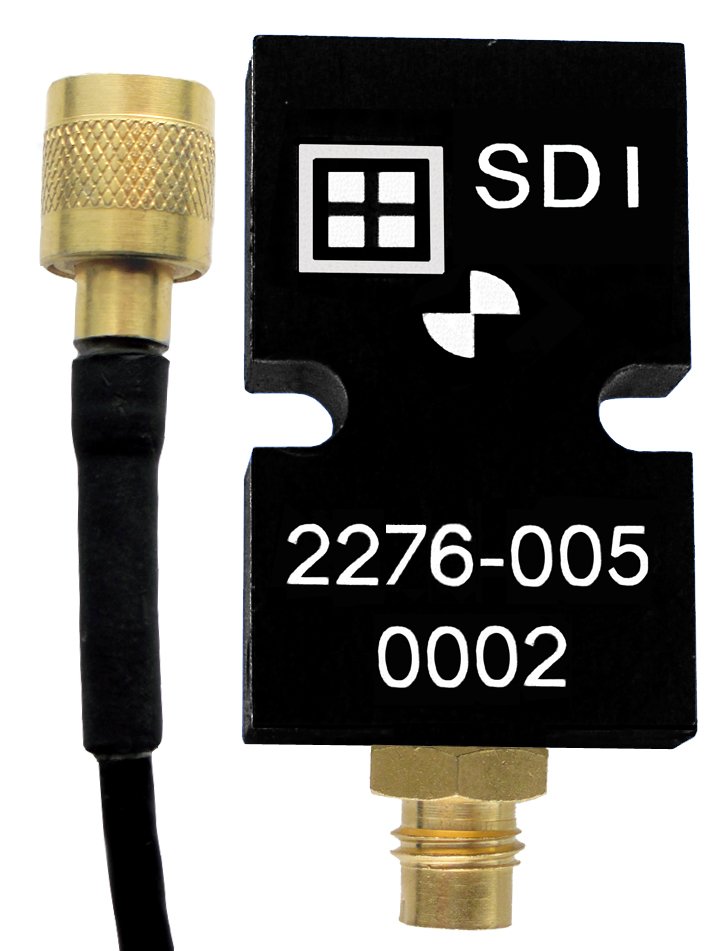
Silicon Designs, Inc., announced its high-performance, Model 2276 Series for zero-to-medium frequency aerospace and automotive testing, industrial vibration monitoring and robotics instrumentation applications.
Available in eight standard ranges from ±2 g to ±400 g, the single-axis Model 2276 Series combines an integrated low-noise, nitrogen-damped, fully calibrated MEMS capacitive accelerometer chip together with high-drive, low-impedance buffering. Sense elements are contained within an epoxy-sealed, rugged anodized aluminum housing. This design allows the Series to reliably withstand shock inputs of up to 5000 g, as well as standard operating temperature ranges from –55°C to +125°C. The accelerometers further offer superior bias performance, including a temperature shift coefficient of -100 to +100 PPM of span/°C, and a scale factor temperature shift coefficient of -150 to +50 PPM/°C. Model 2276 Series accelerometers respond to both DC and AC acceleration, with choice of either two analog ±4 V (differential); or 0.5 to 4.5 V (single-ended) outputs, both of which vary with acceleration. At zero acceleration, output differential voltage is nominally 0 VDC (DC response). Onboard voltage regulation also minimizes supply voltage variation effects.
All Silicon Designs MEMS capacitive accelerometers and chips, including dies, are 100% designed, manufactured, assembled and tested at the company’s state-of-the-art global corporate headquarters and R&D center, located just outside of Seattle, Washington. Each module is serialized for traceability and fully calibrated prior to shipment.
The high-performance, low-impedance design of the Model 2276 Series is ideal for vibration and acceleration measurements within industrial and commercial environments, particularly in applications where an accelerometer’s low mass (9 g) and small size (0.94" by 0.63" by 0.425") can help to minimize mass loading effects on the test article. Typical applications include aircraft flight and flutter testing, automotive RLDA, industrial vibration monitoring and analysis, robotics, biomechanics, industrial machinery and equipment control, modal and structural analysis, crash event detection, and general in-laboratory testing. To learn more about the Model 2276 Series, visit Silicon Designs.