Enabling Digital Transformation in Industrial Environments

The tools that drive data and connection for critical infrastructure and heavy industry
Figure 1: Bird’s-eye view of an FPGA architecture showing an array of programmable logic blocks interconnected by configurable routing.
Whether in the pursuit of greater efficiency, data-driven insights, artificial intelligence (AI) applications, or beyond, businesses across sectors are continuing to pursue digital transformation. In fact, the International Data Corporation (IDC) projects worldwide spending on digital transformation efforts will reach nearly $4 trillion USD by 2027 as companies seek to remain competitive in an increasingly digital Industry 4.0.
Plenty of organizations have already achieved transformation goals or are well on their way to doing so. But this process isn’t always straightforward—especially for those in more traditional industries with well-established operations and frameworks. This is especially true for businesses in the Critical Infrastructure (CI) and Industrial sectors, who are eager to dive into Industry 4.0 but hampered by obstacles ingrained in their infrastructure.
CI and Industrial environments have different demands than other industries and require more powerful components and technologies to ensure that operations stay online. Where unintended downtime in a manufacturing plant may result in wasted material, an outage in the energy sector may cause lengthy blackouts across entire regions. Understanding the challenges that inhibit digital transformation in these sectors—and exploring the technical solutions that can support these efforts within established operations—is key to achieving digital goals in a reliable and sustainable manner.
Obstacles to Transformation in Critical Infrastructure and Industrial Sector
Regardless of your industry, digital transformation is a significant undertaking that requires careful planning and execution. Even so, CI and Industrial environments face their own inherent challenges, including:
· Legacy equipment. Industrial equipment is built to last for decades, meaning many CI environments are still using pre-connectivity-boom equipment. They were not built with networking in mind, making it difficult to integrate into newly connected systems. While Internet of Things (IoT) devices and sensors can help bring this equipment online, they don't fully solve connectivity problems on their own.
· Siloed software. Ad-hoc infrastructure investments over time often lead to disparate solutions with siloed data and capabilities. Teams need to centralize this data to facilitate holistic analysis, but this results in high data volumes and more complicated management requirements.
· Stringent processes and controls. Like with data silos, various processes and controls may be entrenched in existing infrastructure. Adjusting these to fit new systems can be a challenge, especially when dealing with high-risk or high-pressure services.
· Additional security risk. Incorporating new digital solutions expands attack surfaces and opens doors to new threats—and risk in CI and industrial environments is already quite high. Business leaders need to safeguard these critical systems from day one to ensure operations and staff are adequately protected.
Further complicating all of this is the cyber-physical nature of CI and industrial environments. When brought online, they use networked controls to operate physical machinery. The impacts of an issue on either side can have significant ramifications on the other teams working within these facilities need operational and information technology (OT/IT) expertise in equal measure.
In light of these pressures, supportive technologies that can balance modernization with ongoing operations are key to successful digital transformation in industrial settings. One such solution is the Ethernet for Control Automation Technology (EtherCAT) protocol: an Ethernet-based fieldbus protocol designed to support real-time requirements in automation technology.
EtherCAT leverages a “processing-on-the-fly" methodology that allows data to be processed and passed to the next node simultaneously rather than in sequence. This enables systems to operate at higher speeds with lower latency and less jitter than other Industrial Ethernet protocols. EtherCAT is commonly used in modern connected Industrial ecosystems, supporting applications like motor and motion controls, Robotic, machine vision, test and measurement systems, and more.
However, to operate at the level required by Industrial and CI organizations, EtherCAT solutions need to be supported by equally capable hardware. Enhanced semiconductor builds like Field-Programmable Gate Arrays (FPGAs) can help businesses build systems that are up to the task.
Combining EtherCAT with FPGAs for CI and Industrial Systems
Like in an engine or a power grid, every component of a connected digital ecosystem has an important role to play. This is especially true in CI and Industrial systems, where choosing the right hardware can be the difference between smooth operation and catastrophic outages.
In a connected digital infrastructure, chips like semiconductors are the building blocks that create the foundation of your greater ecosystem. The chip(s) you choose determine both your current and future capabilities at the most basic technical level. Some of today's most common chips include:
- ASICs. Application-specific integrated circuits (ASICs) are chips that can be customized for specific use cases rather than general-purpose usage.
- MPUs. Microprocessor units (MPUs) are integrated circuits that compile the capabilities of a central processing unit on a single silicon chip.
- MCUs. Microcontroller units are scaled-down chips that provide processing, memory, and I/O capabilities for specific operations.
- ASSPs. Application-specific standard products help provide off-the-shelf circuit capabilities for specific purposes.
- FPGAs. Field Programmable Gate Arrays are dynamic integrated circuits that enable the development of custom logic for flexible system design.
Each of these chips can be leveraged for specific digital transformation initiatives. But one stands above the rest as a reliable, lowpower, high-output solution for implementing EtherCAT protocol in CI and Industrial solutions: the FPGA. FPGAs are the most advantageous chip for EtherCAT builds due to their:
- Parallel processing. Like EtherCAT’s “processing-on-the-fly" model, FPGAs are capable of carrying out multiple data-processing operations at the same time by leveraging logic gates instead of sequential processing. The combined capacity of EtherCAT and FPGA hardware enables demanding systems to handle complex computing tasks more reliably and efficiently.
- High performance. Amid the industrial sector’s push to automate processes, workload consolidation is helping to reduce costs, simplify systems, and support scalability. EtherCAT and FPGAs are well-suited to virtualization and containerization—key enablers of platform integration.
- Low latency. With parallel processing capabilities baked directly into their hardware, FPGAs create significantly less latency than similar general-purpose chips. This is critical for EtherCAT builds in CI and Industrial applications, where real-time response can be the difference between risk mitigation and catastrophic shutdowns.
- Direct interface. FPGAs’ design flexibility allows for direct integration with EtherCAT protocols, leveraging an MII/RMII MAC interface to support precise operations while maintaining efficiency and security.
- Integrated security features. FPGAs’ built-in security capabilities allow them to be used as a Hardware Root of Trust (HRoT) for EtherCAT-based systems. Their additional Zero Trust and cryptographic features help ensure compliance with industry standards and the protection of critical digital systems.
With the power of EtherCAT and FPGAs, teams can support a number of Industrial and CI use cases. This includes real-time motion control for robotics applications, whose efficiency and precision are vital to automating Industrial machinery. They also support the real-time aggregation and analysis of data from various disparate sensors and devices, helping teams monitor systems and complete test and measurement functions. Lastly, they can support AI and machine learning (ML) applications such as machine vision that help monitor operations and ensure the timely remediation of disruptions.
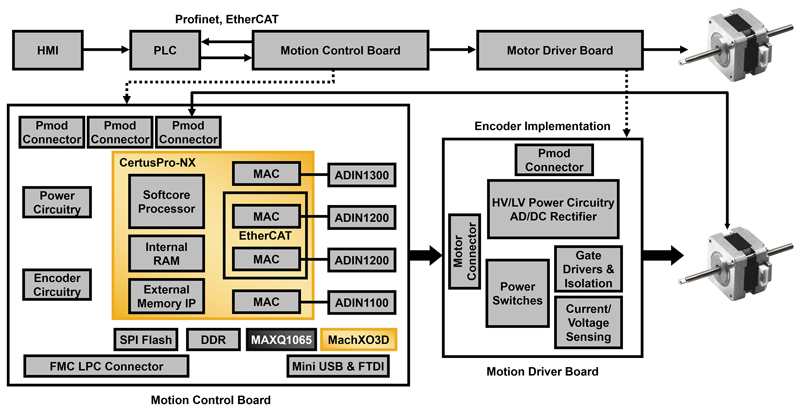
Click image to enlarge
Figure 2: Block diagram of an industrial motion control system integrating a Motion Control Board and Motion Driver Board
Beyond EtherCAT support, FPGAs are well-suited to support general Industrial and CI use cases. Their small formfactor allows for ease of integration into systems from robotics to test and measurement devices, with a low power demand on the overall operating system. FPGAs also offer a high I/O capacity, empowering data transfer and processing at the speed of operations. Lastly, their field programmability allows teams to update FPGAs power-deployment to meet the changing needs of their industry, regulatory requirements, and growing digital infrastructure.
Supporting a Continued Shift Towards Digital Transformation
The complete digital transformation of any industry is not going to happen overnight, let alone the Critical Infrastructure and Industrial sectors. But by building a strong technical foundation and strengthening existing systems, these organizations can create the conditions for future-proof operations and lasting technological success.