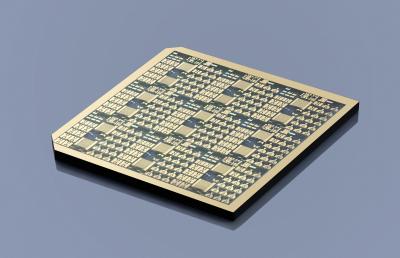
Powerful electronic components are indispensable for future communications, for the digital transformation of society and for artificial intelligence applications. On a footprint as small as possible, they should offer low energy consumption and achieve ever higher power densities, thus working more efficiently. This is where conventional devices reach their limits. Scientists all over the world are therefore investigating new materials and components that can meet these requirements. The Ferdinand-Braun-Institut (FBH) has now achieved a breakthrough with transistors based on gallium oxide (beta-Ga2O3).
The newly developed beta-Ga2O3-MOSFETs (metal-oxide-semiconductor field-effect transistor) provide a high breakdown voltage combined with high current conductivity. With a breakdown voltage of 1.8 kilovolts and a record power figure of merit of 155 megawatts per square centimeter, they achieve unique performance figures close to the theoretical material limit of gallium oxide. At the same time, the breakdown field strengths achieved are significantly higher than those of established wide bandgap semiconductors such as silicon carbide or gallium nitride.
In order to achieve these improvements, the FBH team tackled the layer structure and gate topology. The basis was provided by substrates from the Leibniz Institute for Crystal Growth with an optimized epitaxial layer structure. As a result, the defect density could be reduced and electrical properties improved. This leads to lower on-state resistances. The gate is the central 'switching point' of field effect transistors, controlled by the gate-source voltage. Its topology has been further optimized, allowing to reduce high field strengths at the gate edge. This, in turn, leads to higher breakdown voltages. The detailed results were published online on August 26, 2019 in the IEEE Electron Device Letters September issue.
EurekAlert!, the online, global news service operated by AAAS, the science society: https://www.eurekalert.org/pub_releases/2019-08/fb-epe082719.php


 - small.jpg)