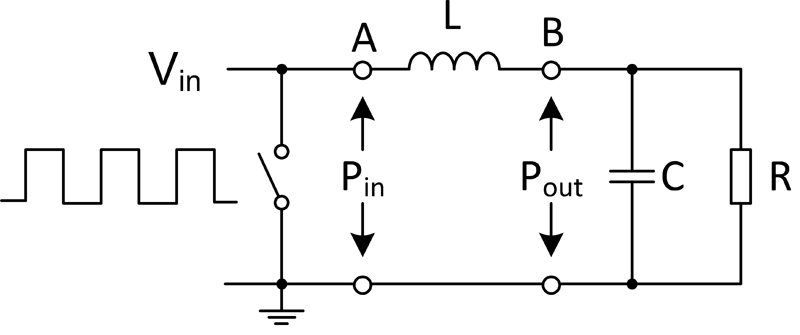
Figure 1. A passive filter at the output of a switching regulator
Linear regulators are outstanding for filtering voltages generated by switching regulators. Switching regulators always have a certain amount of output voltage ripple. In many applications in which very small signals are processed, this ripple can cause interference. Passive components are regularly used to filter the output voltage of a switching regulator, but passive filters such as LC filters (see Figure 1) have a few disadvantages. Depending on the required cutoff frequency of the filter, the space requirements can sometimes be quite considerable, and inductors can be costly. However, the biggest disadvantage of a passive filter is that the filter adds certain losses and output voltages (as with VOUT in Figure 1) that vary based on the operating current. The dc regulation accuracy of the generated voltage is hence quite low.
Linear regulators are often used instead of passive LC filters for cleaning up the voltages generated by switching regulators. They frequently have very high power supply rejection ratios (PSRRs). This means that the input ripple of the linear regulator is—for the most part—blocked so that the output ripple of the linear regulator is very low. In addition, the output voltage of a linear regulator has its own closed loop and is hence well regulated and highly accurate.
Linear regulators also differ in terms of a very important specification, the noise that they generate themselves through their internal reference voltages and their internal error amplifiers. In applications that require low interference (low noise), the interference generated by the linear regulator plays a major role. Ultra-low noise linear regulators are available for this.

Click image to enlarge
Figure 2. A linear regulator as an active filter at the output of a switching regulator
The concept of filtering a voltage generated by a switching regulator with a linear regulator is shown in Figure 2. This scheme not only works for positive voltages but also for negative voltages. A typical use case is a circuit in which a bipolar signal between –5 V and +5 V must be very accurately measured and digitized with an analog-to-digital converter. The input stage of the signal path requires a low-noise bipolar supply with a positive and a negative voltage. For the positive voltage, there are many linear regulators offering high PSRRs and quite low interference on the market. Especially for highly critical applications, Analog Devices offers numerous solutions. For negative voltages, however, there are only a few linear regulators for such an application. For example, the new LT3094 can be used to filter negative voltages at a very high PSRR and features extremely low noise levels important for applications that respond sensitively to interference coming from the power supply. Figure 3 shows the PSRR of the LT3094 at different frequencies. For a switching regulator with a switching frequency of 1 MHz, the LT3094 linear regulator offers a PSRR of about 75 dB. The noise level of the LT3094 lies at just 0.8 μV rms between 10Hz and 100kHz.

Click image to enlarge
Figure 3. Power supply rejection ratio of the LT3094 linear regulator for negative voltages
Linear regulators can filter out power supply ripple for both positive and negative output voltages. This type of filtering is also very useful for the negative voltage range. Due to the limited offering of special low noise types for negative voltages, it is difficult to find a suitable part. With the release of the new Power by Linear LT3094 from Analog Devices, a very low noise option with an exceptionally high PSRR is now available.
Analog Devices