Nanogenerator 'scavenges' power from their surroundings
Imagine a mobile phone charger that doesn't need a wireless or mains power source. Or a pacemaker with inbuilt organic energy sources within the human body.
Australian researchers led by Flinders University are picking up the challenge of 'scavenging' invisible power from low-frequency vibrations in the surrounding environment, including wind, air or even contact-separation energy (static electricity).
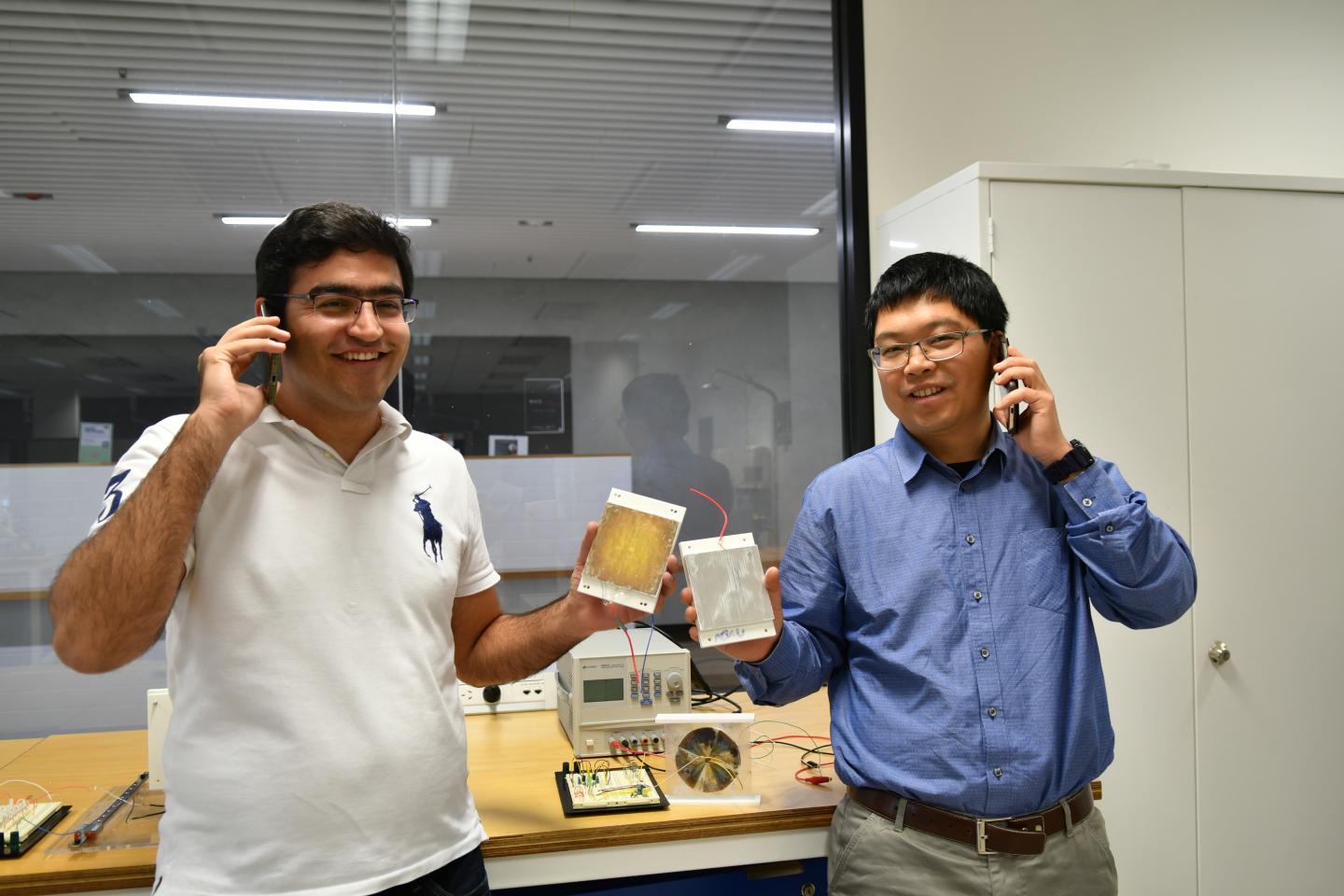
"These so-called triboelectric nanogenerators (or 'TENGs') can be made at low cost in different configurations, making them suitable for driving small electronics such as personal electronics (mobile phones), biomechanics devices (pacemakers), sensors (temperature/pressure/chemical sensors), and more," says Professor Youhong Tang, from Flinders University's College of Science and Engineering.
Further research aims to further develop this renewable form of energy harvesting by designing simple fabrication from cheap and sustainable materials, with high efficiency.
"They can use non-invasive materials, so could one day be used for implantable and wearable energy harvesting aims," says PhD candidate Mohammad Khorsand, co-lead author on recent papers in international journal Nano Energy.
The latest paper uses AI-enhanced mathematical modelling to compare the function of the number of segments, rotational speed and tribo-surface spacing of an advanced TENG prototype to optimise the storage and performance.
The researchers, with colleagues at the University of Technology Sydney and elsewhere, are working to improve power generation of TENGs and store the generated power on supercapacitor or battery.
"We have been able to effectively harvest power from sliding movement and rotary motion which are abundantly available in our living environment," says Professor Tang.
EurekAlert!, the online, global news service operated by AAAS, the science society: https://www.eurekalert.org/pub_releases/2020-10/fu-gvf102120.php