Grid Stability Analytics AI Market To Reach USD 9.7 billion by 2033
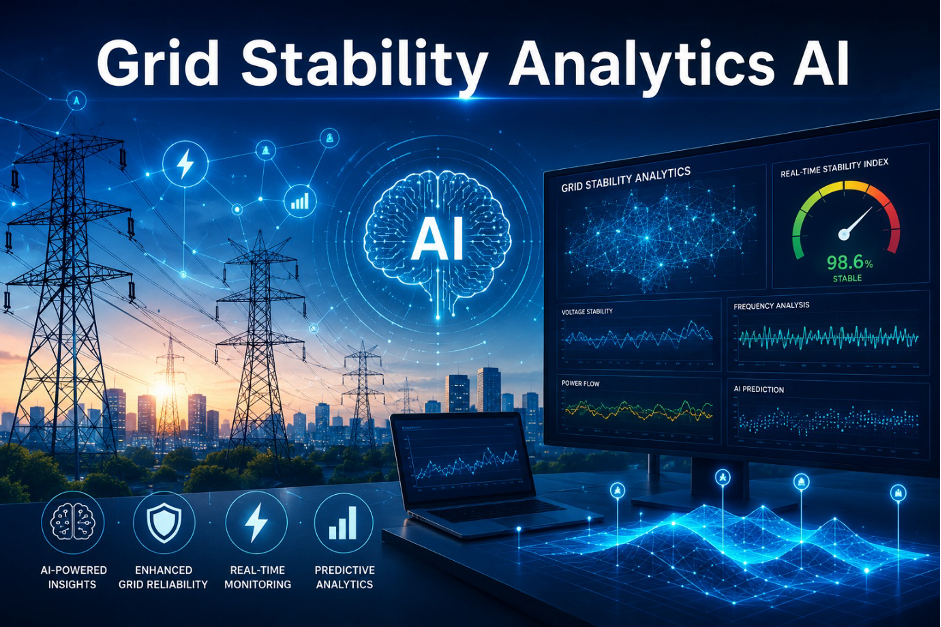
According to our latest research, the global Grid Stability Analytics AI market sizein 2024 stands at USD 2.15 billion, reflecting robust investments in grid modernization and digital transformation. The market is expected to expand at a CAGR of 17.2% from 2025 to 2033, reaching a projected value of USD 9.7 billion by the end of the forecast period. This impressive growth is primarily driven by the increasing integration of renewable energy sources, the need for real-time grid monitoring, and the adoption of advanced AI-powered analytics to enhance grid reliability and efficiency.
Introduction
The global electricity ecosystem is undergoing one of the most significant transformations in history. The rapid integration of renewable energy, electrification of transportation, distributed energy resources, and digital substations has introduced new levels of complexity to power grid operations. Traditional monitoring systems, while reliable for conventional grids, often struggle to manage the dynamic behavior of modern electricity networks. This is where the Grid Stability Analytics AI Market is emerging as a critical technological frontier.
Artificial intelligence is enabling utilities and grid operators to anticipate disturbances before they occur, optimize power flow in real time, and strengthen the resilience of energy infrastructure against unexpected events. Rather than reacting to faults after they happen, AI-powered analytics continuously learn from millions of operational data points, helping utilities maintain frequency stability, voltage balance, and transmission reliability. As energy systems become increasingly decentralized, AI-driven grid stability analytics are becoming an indispensable component of modern power management.
What Is Grid Stability Analytics AI?
Grid Stability Analytics AI refers to the application of artificial intelligence, machine learning, deep learning, predictive analytics, and advanced data modeling to monitor, analyze, and maintain the operational stability of electrical power grids.
Unlike conventional supervisory systems that primarily provide visualization and alarms, AI analytics platforms evaluate enormous streams of real-time operational data to identify hidden patterns, forecast instability, recommend corrective actions, and even automate grid responses.
These intelligent systems combine information from smart meters, PMUs (Phasor Measurement Units), weather forecasting platforms, renewable energy assets, substations, energy storage systems, and transmission networks to create a comprehensive understanding of grid behavior.
Why Is AI Becoming Essential for Grid Stability?
Modern electricity grids are becoming increasingly unpredictable due to variable renewable generation. Solar power output changes with cloud movement, while wind generation fluctuates with atmospheric conditions. Simultaneously, electric vehicle charging, industrial electrification, and decentralized power production introduce additional operational complexity.
Artificial intelligence addresses these challenges by processing vast datasets much faster than conventional analytical tools. AI models continuously detect abnormal operating conditions, forecast demand fluctuations, predict voltage instability, identify oscillation risks, and optimize energy balancing across interconnected networks.
Instead of relying solely on historical operating rules, AI adapts continuously as the grid evolves, allowing utilities to make smarter operational decisions.
Key Technologies Driving the Grid Stability Analytics AI Market
Machine Learning for Predictive Grid Operations
Machine learning algorithms analyze years of historical operational data alongside real-time measurements to forecast equipment failures, demand surges, transmission congestion, and frequency deviations. Continuous learning improves forecasting accuracy as new operational scenarios emerge.
Digital Twins of Power Grids
Digital twins create virtual replicas of physical electricity networks. AI simulations allow utilities to test different operating conditions, renewable penetration levels, and emergency scenarios without affecting the actual grid. This significantly improves planning and risk management.
Edge AI for Faster Decision-Making
Rather than sending every data point to centralized cloud systems, Edge AI processes critical information directly within substations or field devices. This enables ultra-fast detection of disturbances and supports near-instantaneous corrective actions during grid events.
Deep Learning for Pattern Recognition
Deep neural networks excel at identifying complex relationships between weather patterns, consumer demand, renewable generation, and transmission performance. These insights enable highly accurate forecasting that traditional statistical models often cannot achieve.
Explainable Artificial Intelligence
Utilities require transparency when making operational decisions. Explainable AI provides understandable reasoning behind algorithmic recommendations, helping engineers trust AI-assisted actions while satisfying regulatory and operational requirements.
How AI Improves Power Grid Reliability
AI-powered stability analytics continuously monitor multiple indicators simultaneously, including voltage fluctuations, harmonic distortion, reactive power imbalance, transformer loading, transmission line performance, and generator synchronization.
When abnormalities begin to develop, AI identifies their probable causes, estimates potential consequences, and recommends preventive measures before customer outages occur. This proactive approach minimizes service interruptions while improving grid resilience.
Advanced systems can also coordinate battery storage, renewable generation, and flexible demand resources to stabilize power systems during periods of rapid change.
Major Applications Across the Energy Sector
Grid Stability Analytics AI has applications across nearly every segment of the modern electricity industry.
Transmission system operators use AI to optimize interconnection stability and prevent cascading failures across regional networks. Distribution utilities rely on predictive analytics to manage localized voltage fluctuations caused by rooftop solar installations. Renewable energy developers integrate AI to improve wind and solar forecasting accuracy. Industrial facilities utilize grid analytics to enhance power quality and minimize operational disruptions.
Energy storage operators increasingly depend on AI to determine optimal charging and discharging schedules that maximize both economic value and grid stability.
What Factors Are Driving Market Growth?
Several global trends are accelerating investment in Grid Stability Analytics AI.
The worldwide expansion of renewable energy has significantly increased variability within electricity systems, creating demand for intelligent forecasting tools. Smart grid modernization programs are generating unprecedented volumes of operational data that require AI-driven interpretation. Governments are encouraging digital transformation of critical infrastructure to improve energy security and resilience.
Meanwhile, utilities are facing growing pressure to reduce outage durations, improve operational efficiency, optimize maintenance spending, and meet ambitious decarbonization targets—all of which benefit from advanced analytics.
Cloud computing, high-speed communication networks, and affordable sensor technologies are further lowering barriers to AI deployment across utility operations.
Challenges Limiting Market Expansion
Despite impressive progress, several challenges continue to influence adoption.
Many utilities operate aging infrastructure that was not originally designed for AI integration. Data quality inconsistencies, fragmented operational systems, cybersecurity concerns, and interoperability limitations can complicate implementation.
Developing accurate AI models also requires extensive historical datasets, which may not be readily available for every grid configuration. Additionally, organizations must train engineers and operators to effectively interpret AI-generated recommendations and integrate them into existing operational workflows.
Regulatory approval processes for autonomous grid decision-making remain an evolving area in many regions.
Emerging Trends Reshaping the Industry
Several technological innovations are expected to redefine the future of Grid Stability Analytics AI.
Federated learning is enabling utilities to improve AI models collaboratively while preserving data privacy. Autonomous grid control systems are becoming increasingly capable of making real-time operational adjustments with minimal human intervention.
Quantum computing research may eventually accelerate complex power flow simulations that currently require significant computational resources.
Generative AI is also beginning to assist engineers by summarizing operational events, generating maintenance recommendations, and simplifying technical reporting.
Integration with satellite weather forecasting, IoT sensor networks, and advanced energy storage optimization platforms will continue expanding AI's capabilities in power system management.
Competitive Landscape
- Siemens AG
- General Electric Company
- ABB Ltd
- Schneider Electric SE
- Oracle Corporation
- IBM Corporation
- Hitachi Energy
- AutoGrid Systems
- Eaton Corporation
- Honeywell International Inc.
- Mitsubishi Electric Corporation
- Wartsila Corporation
- Open Systems International (OSI)
- C3.ai
- Uptake Technologies
- Grid4C
- Spirae Inc.
- Indra Sistemas S.A.
- Landis+Gyr
Future Outlook
According to our Growth Market Report, The Grid Stability Analytics AI Market is evolving into a foundational pillar of the global energy transition. As electricity networks become more decentralized, digitally connected, and renewable-powered, maintaining grid stability will require intelligence far beyond conventional automation. Artificial intelligence offers the capability to transform reactive power management into predictive and adaptive decision-making, enabling utilities to anticipate disruptions, optimize energy flows, and respond to changing conditions with remarkable speed and precision. Future advancements in autonomous grid control, real-time digital twins, federated learning, and AI-enhanced cybersecurity will further elevate the reliability and resilience of power systems. As governments, utilities, and private stakeholders continue investing in smarter infrastructure, Grid Stability Analytics AI will move from being a competitive advantage to an operational necessity, shaping a more sustainable, secure, and intelligent energy future for communities around the world.
Source