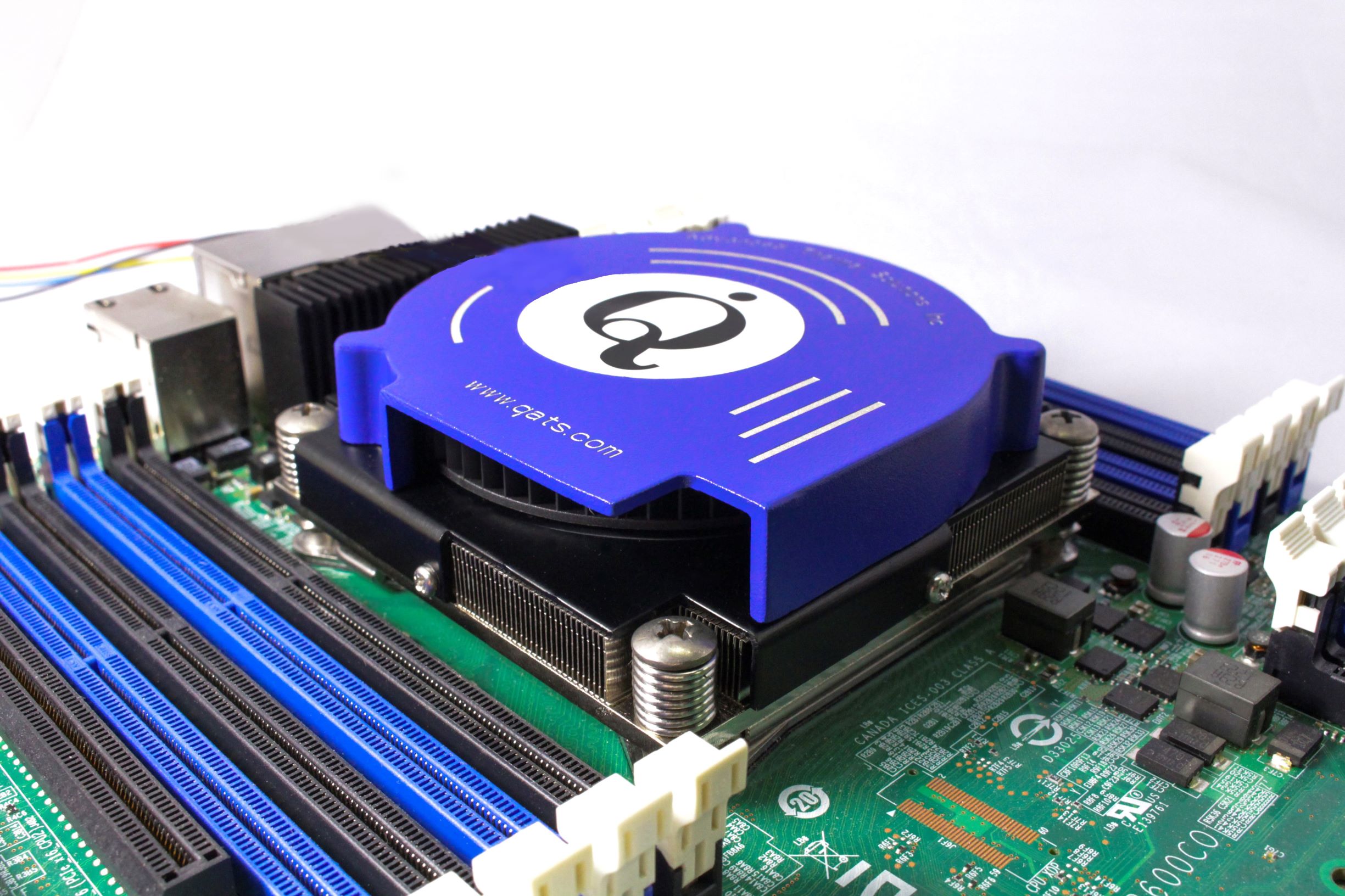
Advanced Thermal Solutions, Inc, ATS, now provides a family of ultra-high performance heat sinks for cooling high powered CPUs, GPUs, FPGAs and AI processors. This ultra-cool family includes active heat sinks with integral blowers, and passive heat sinks that use available airflow to provide thermal management.
The active heat sinks, dualFLOW and quadFLOW are designed for use on moderate to high component density PCBs, including 1U and 2U boards.
The sinks feature an aluminum or copper straight fin base, with a powerful blower on top. dualFLOW heat sinks draw air from two opposite directions, and quadFLOW sinks pull air from all four linear sides. The fast moving, high volume air helps maximize thermal performance on crowded boards and tight enclosures with insufficient airflow for passive cooling
The passive (fanless) cooling solutions in ATS’ ultra-cool family are straight-fin heat sinks. They come in blue anodized aluminum or nickel-plated copper depending on thermal performance and weight requirements. They are ideal for systems with open airflow from front to back. Aluminum fins reduce the overall weight, while copper fins spread heat more efficiently for better thermal performance.
All ATS ultra-cool heat sinks fit standard Intel LGA 2011 sockets (Socket R) square and LGA 2066 sockets (Socket R4) commonly used in high-end cloud and edge server applications. An optional backing plate is available for applications other than the Intel LGA 2011 socket. The backing plate attaches beneath the PCB to avoid damaging the board when attaching the cooler.
The heat sinks can be securely attached using PEM screws and springs that provide firm contact to the hot component for optimum heat dissipation. The dualFLOW and quadFLOW cooling devices are available with a vapor chamber base in place of an aluminum or copper heat sink base.
All ATS ultra-cool heat sinks are available from ATS’ worldwide distribution network that includes Digi-Key Electronics and Mouser Electronics. More details are found on Qats.com.