Improving EV Power w/ High Step-Down Ratio DC/DC Converters
The need to combat global warming has prompted many countries to establish vehicle emission mandates, with the most severe restrictions enacted in Europe
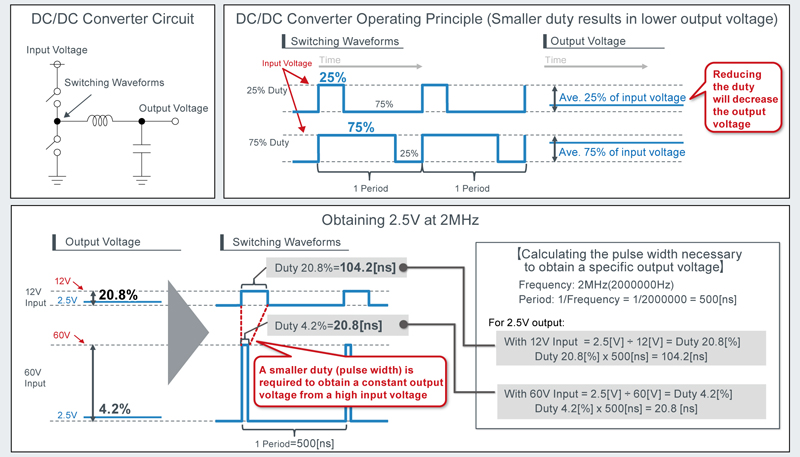
Figure 1: Relationship between Duty Cycle and Output Voltage
To achieve the regulatory limits set by a number of countries worldwide, automakers are increasingly working on developing electric vehicles.
Currently, 5 types of electric vehicle technologies are being employed: Pure EV, powered solely by electricity, Fuel Cell EV that runs on fuel cells, Strong Hybrid, which charges using regenerative energy and supports electric-only operation, Plug-In Hybrids that can be charged with a standard AC outlet, and Mild Hybrid that adds a 48V li-ion battery to conventional 12V vehicle systems to supply more power to the hybrid motor and support heavier load components while still improving fuel efficiency.
How does the shift towards electric motors improve fuel economy? In the case of conventional vehicles with gasoline-powered engines, a lead-acid battery charged by the alternator powers all electrical systems, including lighting and AC. Consequently, fuel efficiency decreases as the electrical systems are used, whereas in electric-powered vehicles regenerative energy (i.e. generated through braking) charges a lithium-ion battery that powers the electrical systems. This reduces the amount of engine power used, improving fuel economy.
Strong Hybrid and Plug-In Hybrid systems are extremely effective in reducing CO2 emissions, but they entail significant additional costs and are difficult to install in compact vehicles. As a result, 48V Mild Hybrid systems that provide a lower-priced solution while still reducing CO2 emission compared with conventional 12V vehicles are attracting increased attention. In fact, according to IHS, roughly 50% of the hybrid market, or 1 out of 10 vehicles sold worldwide, will be a 48V Mild Hybrid.
Power Supply ICs for Mild Hybrid EVs
The main difference between Mild Hybrid and standard vehicles is the power supply voltage of the battery. Mild Hybrid systems utilize a 48V battery, 4x the voltage of internal combustion (IC) systems (12V). And because all other elements remain the same (including ECUs), the input/output voltage difference is significantly increased.
Consequently, DC/DC converters with high step-down ratio capable of generating a low output voltage from a much higher input voltage are required. Furthermore, to prevent radio interference in vehicle-mounted power supply ICs, a switching frequency of 2MHz is needed to ensure that the AM radio band (0.5MHz to 1.7MHz) is not affected.
Until now, it was common to use 2 chips for stepping the voltage down from 48V to the 3.3V or 5V demanded by ECUs (48V→12V→3.3V/5V). However, this doubles the number of peripheral components, increasing mounting area significantly. There is a way to use just one chip by lowering the frequency to convert voltage, but this method requires larger coils and capacitors that generate harmonics which can interfere with the AM radio band.
For these reasons, there is an increasing demand for DC/DC converters capable of directly stepping down 48V input to 3.3V or 5V output at a switching frequency higher than the AM radio band. But to achieve this a number of obstacles must first be overcome.
Monolithic Power Supply IC Featuring Ultra-Narrow Pulse Width
One technical hurdle for achieving lower output voltage from a higher input voltage at high frequency is narrowing the switching pulse width. The switching pulse width of a DC/DC converter is a function of the input voltage, output voltage, and switching frequency, and is calculated using the following formula:

(ton: Switching Pulse Width, VOUT: Output Voltage, VIN: Input Voltage, f: Switching Frequency)
Equation 1. Calculating Switching Pulse Width
As can be seen from the above equation, the switching pulse width narrows as the input voltage increases, output voltage decreases, and/or frequency rises. Therefore, a method for reducing the switching pulse width is required for 48V Mild Hybrid systems. But to reduce pulse width it is first necessary to solve problems related to noise generation during switching.
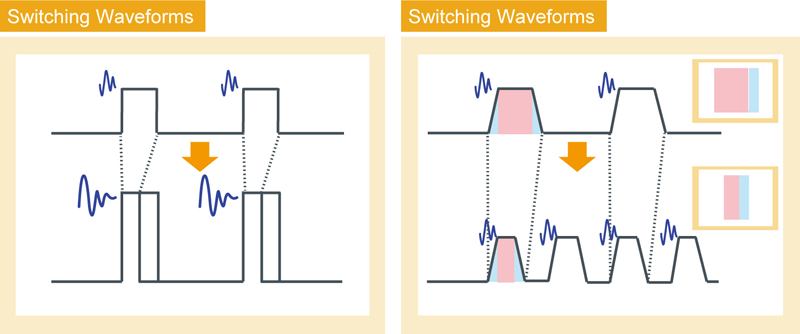
Increasing the input voltage will cause the noise component to increase during switching due to parasitic inductance contained in the IC. The noise component will also rise at high frequencies, resulting from the higher switching frequency and parasitic capacitance of the element (Fig. 2).
Click image to enlarge
Figure 2: Noise Components Increase at Higher Voltages and Frequencies
When this switching noise is introduced into the IC unstable operation may occur. To prevent this, conventional control methods utilize mask time. An analog circuit is also required for operation, which introduces a delay time. These two factors that arise due to the increased noise component cause the pulse width to become wider. Therefore, analog control is needed that leverages high voltage processes along with ultra-fast pulse control circuitry to detect information before noise is generated and perform appropriate control.
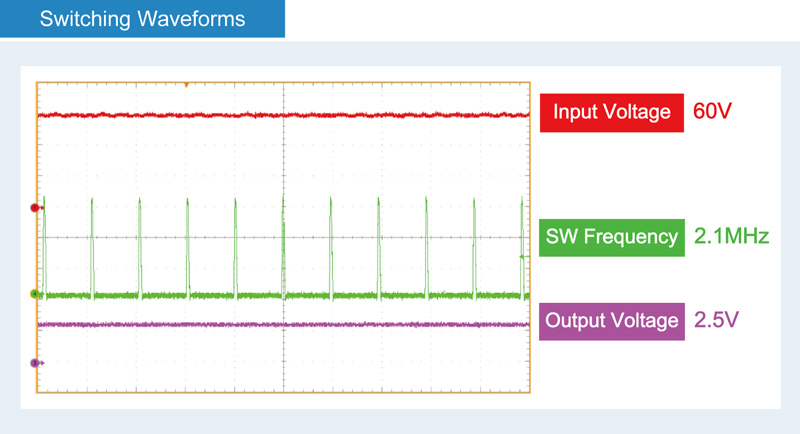
The pulse width required to output 3.3V from 60V (the maximum voltage needed for 48V power supplies) is 30ns, but when considering load and power supply fluctuations within the IC a narrower pulse width is necessary. Ideally, the pulse width should be less than 20ns to achieve a step-down ratio of 24:1 (Fig. 3). This will make it possible to provide stable 2.5V output from an input voltage range of 16V to 60V at a high frequency of 2MHz or more.
Click image to enlarge
Figure 3: Achieving Direct Step-Down from 60V to 2.5V at 2.1MHz
Adopting this technology will allow users to configure DC/DC converters capable of stepping down 48V to 3.3V using a single chip, instead of conventional systems that require 2 chips to first convert 48V to an intermediate voltage such as 12V, then from 12V to 3.3V.
At the same time, care needs to be taken to prevent IC destruction in the event of abnormalities. For example, when converting high input voltages to low output voltages, if the output and switching terminals are shorted a large amount of energy will be generated, causing large current flow which can lead to destruction in ICs employing conventional short-circuit detection methods. Therefore, a new type of protection technology is required for detecting abnormalities beforehand to protect the IC against large currents. Also, adopting a wettable flank package that provides superior wettability and visibility can contribute to improved mounting reliability for xEV applications.
Conclusion
Reducing CO2 emissions in vehicles is a major challenge and improving fuel efficiency an important step in achieving this goal. To this end, 48V mild hybrid vehicles that provide good cost performance is expected to see increased production – to the tune of 14 million vehicles by 2025 (a ninefold increase over current levels).
ROHM offers optimized solutions utilizing proprietary Nano Pulse technology that can lead to smaller, simpler power supplies in mild hybrid systems by providing considerable advantages over existing products.
ROHM Semiconductor