Smoother materials and broader range of wavelength capture
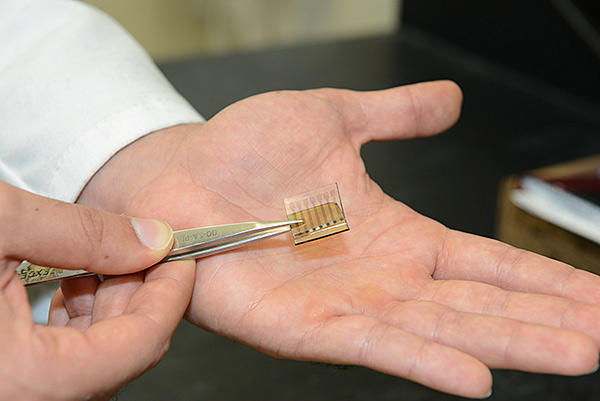
Stanford University scientists have built the first solar cell made entirely of carbon and are focused on improving the 1% efficiency, which much lower than commercially available solar cells. The paper has appeared in online edition of the journal ACS Nano. Senior author Zhenan Bao, a professor of chemical engineering, believes this "is the first demonstration of a working solar cell that has all of the components made of carbon. "Carbon has the potential to deliver high performance at a low cost," she says. "Perhaps in the future we can look at alternative markets where flexible carbon solar cells are coated on the surface of buildings, on windows or on cars to generate electricity." The coating technique also has the potential to reduce manufacturing costs. "Processing silicon-based solar cells requires a lot of steps, but our entire device can be built using simple coating methods that don't require expensive tools and machines" said Stanford graduate student Michael Vosgueritchian, co-lead author of the study with postdoctoral researcher Marc Ramuz. The experimental solar cell consists of a photoactive layer, which absorbs sunlight, sandwiched between two electrodes. In a typical thin film solar cell, the electrodes are made of conductive metals and ITO (indium tin oxide). "Materials like indium are scarce and becoming more expensive as the demand for solar cells, touchscreen panels and other electronic devices grows," Bao said. "Carbon, on the other hand, is low cost and Earth-abundant." The Bao group's all-carbon solar cell consists of a photoactive layer, which absorbs sunlight, sandwiched between two electrodes. For the study, the researcher replaced the traditional silver and ITO used in conventional electrodes with graphene . "Carbon nanotubes have extraordinary electrical conductivity and light-absorption properties," she said. For the active layer, carbon nanotubes and "buckyballs" - soccer ball-shaped carbon molecules just one nanometer in diameter were used. The research team recently filed a patent for the entire device. One drawback of the all-carbon prototype is that it primarily absorbs near-infrared wavelengths of light, contributing to a laboratory efficiency of less than 1% - much lower than commercially available solar cells. The Stanford team is looking at a variety of ways to improve efficiency. "Roughness can short-circuit the device and make it hard to collect the current," Bao said. "We have to figure out how to make each layer very smooth, by stacking the nano-materials really well." Researchers are also experimenting with carbon nano-materials that can absorb more light in a broader range of wavelengths, including the visible spectrum. "Materials made of carbon are very robust," Bao said. "They remain stable in air temperatures of nearly 1,100 degrees Fahrenheit." Stamford University