An evolving dynamic between innovation and national security demands.
Figure 1: “Business model development process, experimentation, and Lean Start-up in practice” (Source: Bokur and Snihur, 2020)
National security increasingly relies on swift innovation and rapid inventory upgrades to maintain agility on a global scale. Program modernization and capability improvements are top priorities to meet urgent national security demands, with speed, innovation, and reliability driving success. Asprivate companies surpass government entities in tech investments, government procurement and research and development (R&D) require an efficient approach to catch up. Adopting business techniques similar to those of a tech startup, such as the Learn Startup methodology, would not only drive national security innovation, but also promote acceleration within the tech landscape as a whole.
In this article, I synthesize national security analysis with AI trends to show how acquisition and development models evolve over time. Using industry examples, I highlight instances where the sector has successfully adopted a lean approach to optimize resource allocation and accelerate design iterations, ultimately remaining nimble in response to emerging technologies.
The Lean Startup Model
Traditionally, companies use capital and time-intensive methods to steer product development, usually increasing their risk and upfront financial commitment in turn. When market conditions change, alterations to products can render previous investments obsolete, effectively turning them into sunk costs. Companies that follow this traditional design method find it challenging and expensive to pivot or change course as they are forced to absorb losses.
In contrast, the Lean Startup methodology—coined in the 2010s to describe Silicon Valley startup culture —calls for the integration of market research and customer feedback throughout a project's lifecycle, especially within a company or product’s early stages. This process facilitates the simultaneous collection of data and rapid iteration of the product, allowing constant refinement and improvement. The model’s product design cycle incorporates constant customer input, continuous product testing, iterations, and data analyses, as illustrated in Figure 1.
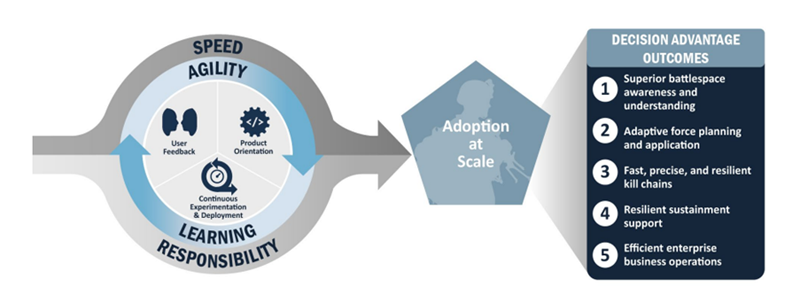
Although the government is not a startup, its programs are beginning to adopt a design, iteration, testing/qualifications, and final production process similar to that of a startup utilizing the Lean Startup methodology.When applied to national security, the Lean Startup model provides a foundational framework for program acquisition and design to particularly optimize speed and precision. Figure 2 illustrates a 2023 government program procurement strategy to leverage lean techniques.
Click image to enlarge
Figure 2: “Employing an Agile Approach to Adoption to Scale Decision Advantage Outcomes” (Source: DoD, 2023)
First Mover Advantage
With the rising adoption of AI taking place on a global scale, speed, coupled with program reliability and modernization,is now a prerequisite for technological advancement. The notion of the “first mover advantage” suggests that the first country to effectively utilize AI's capabilities will gain a significant edge. The edge is the “first to innovate and invest, first to reveal, first to maneuver and first to employ,” according to the RAND National Security Research Division (NDRI).
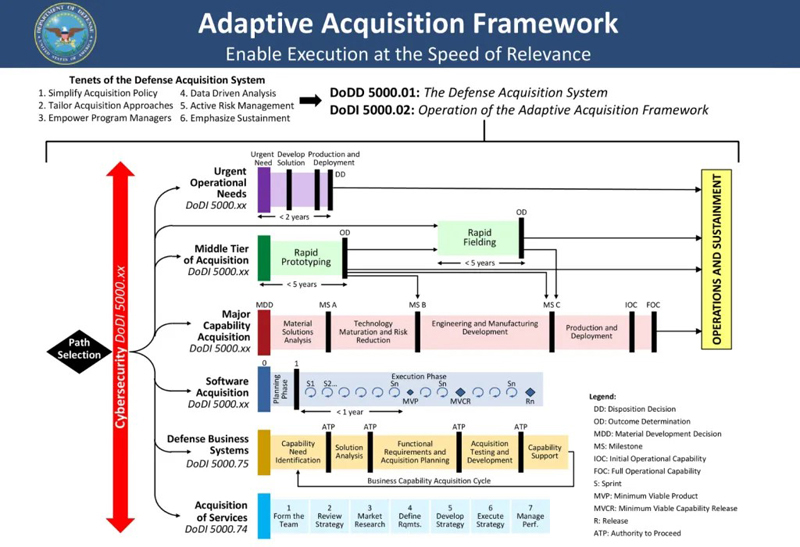
An agile approach to AI-driven initiatives ensures that new technology meets market demands. Agile product development and design, commonly used by many high-growth startups today, consistently incorporate feedback and research insights to enable key features, such as AI-assisted rapid decision-making, in an already time-sensitive market. Figure 3 illustrates a 2019 DoD framework to accelerate such acquisition.
Click image to enlarge
Figure 3 “Adaptive Acquisition Framework: Enable Execution at the Speed of Relevance” (Source: Department of Defense, 2019)
Current efforts echo the need for speedier processes: a 2025 Executive Order calls upon this Adaptive Acquisition Framework to promote “effective, suitable, survivable, sustainable, and affordable solutions to the end user in a timely manner” in relation to procurement and other commercial services. The same Executive Order establishes a Configuration Steering Board to streamline decision-making, risk management, and reduce redundancies within acquisition pathways.
Minimum Viable Product (MVP): Acquisition Framework, Commercial, and SDA
Government program development currently requires considerable time, especially for R&D efforts, testing, qualification, material sourcing, and approvals prior to production. The Lean Startup design cycle addresses this inefficiency by developing a minimum viable product (MVP): essentially, a simpler, operational version of a product. MVPs allow for more flexibility in product iteration and development.
In 2020, the Adaptive Acquisition Framework established acquisition pathways based on categories such as “Major Capability Acquisition,” “Urgent Capability Acquisition,” etc., to offer adaptable procedures, giving primes flexibility in their MVP development process. Low-rate initial production (LRIP), in this case, may function as the MVP for the final product. Product changes can then be implemented more readily during this phase for an optimized design cycle.
Alternatively, AI-empowered industry use cases and commercial applications act as a form of MVP for government programs as well. Treating industry developments as the operational MVP may strengthen industry-government partnerships. Private-public sector collaborations may function as the catalyst for accelerating tech integration in legacy programs. For example, advancements in the commercial electric vehicle space may be considered an MVP for military vehicle electrification developments, and, by extension, other technology-integrations.
The space defense sector is already embracing the Lean Startup design model, and it is the closest to an MVP for tech-forward national security programs. The Space Development Agency (SDA) considers itself the “constructive disruptor for space acquisition,” making decisions based on speed, delivery, and agility. The idea is that dependable security systems will only be reliable if they match the speed of threat. In a way, the SDA itself is a minimum viable product (MVP) for other departments looking to increase their speed and agility in acquisition and innovation. Recent successes in the SDA demonstrate the possibility to balance timeline pressures with high reliability needs for national security readiness.
No matter the approach to integrating lean techniques to government programming, the need for such agile processes remains unchanged. A memorandum as recent as November 2025 calls to “dramatically accelerate” the proliferation of new technologies in the national security sector. The same memorandum provides guidance on flexible contracting, increased communication, and even heightened hiring to aid this process.
Tradeoffs and Guardrails
While AI provides an optimistic outlook for innovation, government national security programs also navigate tradeoffs between technology integrations, deadlines, and readiness. This means choosing between delivering a full-capability, technology- and AI-integrated product with a long lead time or settling for simpler technology to avoid delays and fortify inventory for current national security needs. Urgent national security needs make it difficult for programs to fully develop AI-based systems that other global superpowers are rapidly iterating for.
As a counterbalance, federal defense contracts now shift a portion of their procurement towards newer, agile primes. Traditional primes with longer development cycles face competition from startups with nimble structures. Fixed price contracts, especially, transfer cost overrun burden onto the supplier. Thus, lean primes can more easily redistribute resources and adjust production, R&D, and sourcing costs to account for design changes. In other words, flexibility better shields primes from business risks caused by cost overruns.
The sector continues to investigate responsible AI use and necessary guardrails, such as responsible data management, to meet the speed required with the Lean Startup approach.
Balance of AI-integrated Innovations and Immediate National Security Readiness
The Lean Startup approach offers a structured framework for minimizing costs and facilitating agile design cycles, enabling primes to adapt to the rapidly evolving landscape of AI technologies. By leveraging frameworks in the Lean Startup model, national security readiness can be accelerated by adopting emerging commercial technologies and establishing a first-mover advantage in the global market. AI may be essential for resolving mission-critical issues, but paradoxically, integration of AI into legacy systems also poses as a challenge. We’re starting to see primes leverage private-public sector partnerships to balance time-technology tradeoffs. From the program procurement perspective, AI is also shifting the government acquisition and design pathways, with a focus on speed, agility, and leaner processes.
International Rectifier HiRel Products Inc. (IR HiRel), an Infineon Technologies company, sits at the Goldilocks zone of meeting private and public sector needs, optimally positioned for innovation, speed, and reliability. Infineon Technologies is an industry leader in power components with expertise across its broad product portfolio. Through working closely with customers on program designs, providing longevity assurance, and leveraging Infineon commercial teams’ cutting-edge technology, IR HiRel provides an additional layer of reliability for customers with applications in rugged environments.