KEMET Introduces 150 Degrees Celsius Automotive Qualified Polymer Electrolytic Capacitors
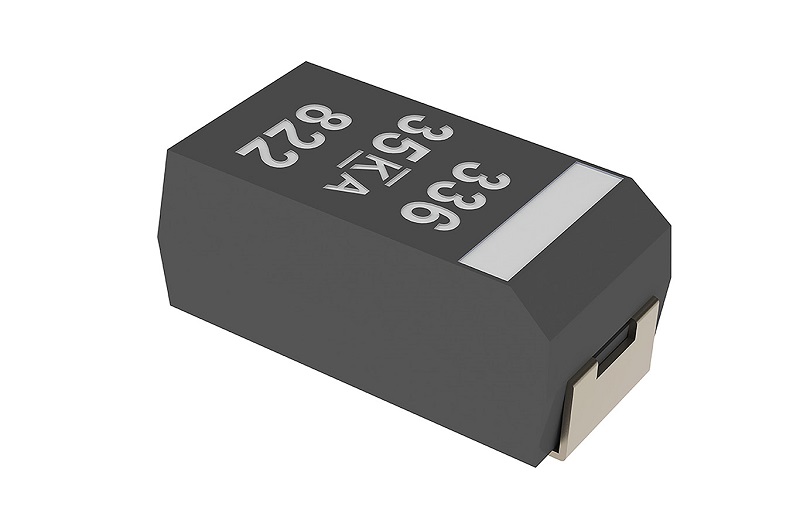
T599 KO-CAP Designed for High Humidity/Temperature Applications
KEMET introduced its first 150°C Automotive KO-CAP capacitor. The T599 KO-CAP High Humidity/High Temperature Performance Polymer series delivers stability and endurance under harsh humidity and temperature conditions.
Building on the success of the T598 series, KEMET further refined the design, materials and manufacturing to ensure T599 delivers higher stability and endurance under harsh conditions. T599 capacitors pass 1,000 hours of humidity bias testing under 85°C with 85% relative humidity at rated voltage, and endurance testing at 150°C up to 1,000 hours, rendering it the only 150°C AEC-Q200 qualified polymer electrolytic capacitor available today.
“Since 2015, T598 capacitors have offered engineers a breakthrough in high capacitance, low ESR and long lifetime with full AEC-Q200 qualification,” said Dr. Philip Lessner, KEMET Senior Vice President and Chief Technology Officer. “Over the last two years, designers have utilized polymer electrolytic capacitors in space-constrained or high-performance applications. Now that KO-CAPs meet both 150°C and AEC-Q200 guidelines, automotive engineers can incorporate these innovative devices into powertrain designs.”
Qualification is compliant with AEC-Q200 guidelines and parts are manufactured in an ISO TS 16949 certified plant. T599 is also available for Production Part Approval Process (PPAP), Part Submission Warrant (PSW) and change control notification.
For more information, please visit www.kemet.com/T599