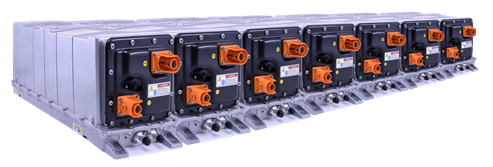
Kokam Co., Ltd, the worlds premier provider of innovative battery solutions, today introduced the XPAND battery pack, delivering electric vehicle manufacturers a safe, high performance, cost-effective battery solution for electric bus, tram, truck, ground support equipment (GSE), military, marine, special-purpose and other commercial and industrial electric vehicle (EV) applications.
The XPAND battery pack will be offered in two versions XMP71P, a 7.1 kilowatt hour (kWh) version, and XMP114E, a 11.4 kWh version. Both versions are easily scalable, able to support EV applications from 7.1 kWh up to 1.5MWh of capacity, in a wide variety of voltages.
While cost and performance are important considerations for electric bus, tram and other EV manufacturers when selecting a battery, safety is their number one priority, said Ike Hong, vice president of Kokams Power Solutions Division. With XPAND, Kokam now offers manufactures an EV battery pack that has been tested and certified to be one of the safest EV battery solutions on the market while still offering high levels of performance at a competitive price.
Battery Safety
The result of four years of extensive R&D and product development efforts, the new XPAND battery pack features advanced battery technologies that meet or exceed practically all existing standards for EV battery safety. For example, the battery cells ceramic separator and other battery pack thermal containment technologies prevent thermal runaway propagation. These and other advanced battery technologies enabled the XPAND battery pack to secure an IP67 rating, confirming that it is fully protected from dust and can be submerged in 1 meter of water for up to 30 minutes. In addition, the XPAND battery pack has been developed according to ISO 12405, ECE R100, J2929, and ISO 26262 standards and is UN38.3 certified.
Innovative Technology Delivers Cost-Effective, Reliable EV Battery Performance
While delivering unparalleled battery safety, the XPAND pack also provides a high-level of cost-effective performance to the EV market. The XPANDs advanced liquid cooling system offers direct cooling to the battery cells face, maximizing volumetric efficiency by reducing the mass of the system by up to 75 percent compared to air-cooled systems. These and other advanced battery technologies allow the XPAND battery pack to achieve an energy density of up to 150 watt hours per kilogram (Wh/kg).
XPAND is also built to lastthe XMP71P battery packs 40Ah Lithium Nickel Manganese Cobalt (NMC) Oxide cells have a long lifespan with cycle lives of over 6,000 cycles. XPANDs modular plug-and-play design, with all external connections on the front panel, makes it easy to engineer XPAND into a wide variety of EV applications and service the battery pack in the field. XPANDs state-of-the-art BMS features diagnostics, battery state estimate and a flexible system architecture, providing more accurate State of Charge (SOC) and State of Health (SOH) data, helping EV operators more accurately estimate how long they can continue to drive their EV before recharging. The battery system has been tested to meet the strict electromagnetic compatibility (EMC) requirements of international marine and transportation customers in North America, Europe, and Asia.
Meeting the Battery Needs of the Growing EV Market
Manufactured in the United States in a fully automated, 700 megawatt hour (MWh) cell manufacturing and pack assembly facility, XPAND addresses the rapidly growing market for electric bus, tram and other commercial and industrial EV battery solutions. For example, research firm Technavio recently predicted that the global electric bus market will grow at a compound annual growth rate (CAGR) of almost 27 percent between 2016 and 2020.
As the world continues to accelerate its transition to a cleaner, more efficient electricity-based economy, the demand for electric buses, trams and other commercial and industrial EVs is growing at a rapid pace as is the competition in this market, said Hong. Several major EV manufacturers who have started using XPAND believe it will provide them with a competitive advantage in this growing market, enabling them to easily engineer into their EVs a cost-effective, high performance battery solution that not only meets, but exceeds, their safety requirements.