KYOCERA AVX Announces New Additions to MIL-PRF-39006 QPL
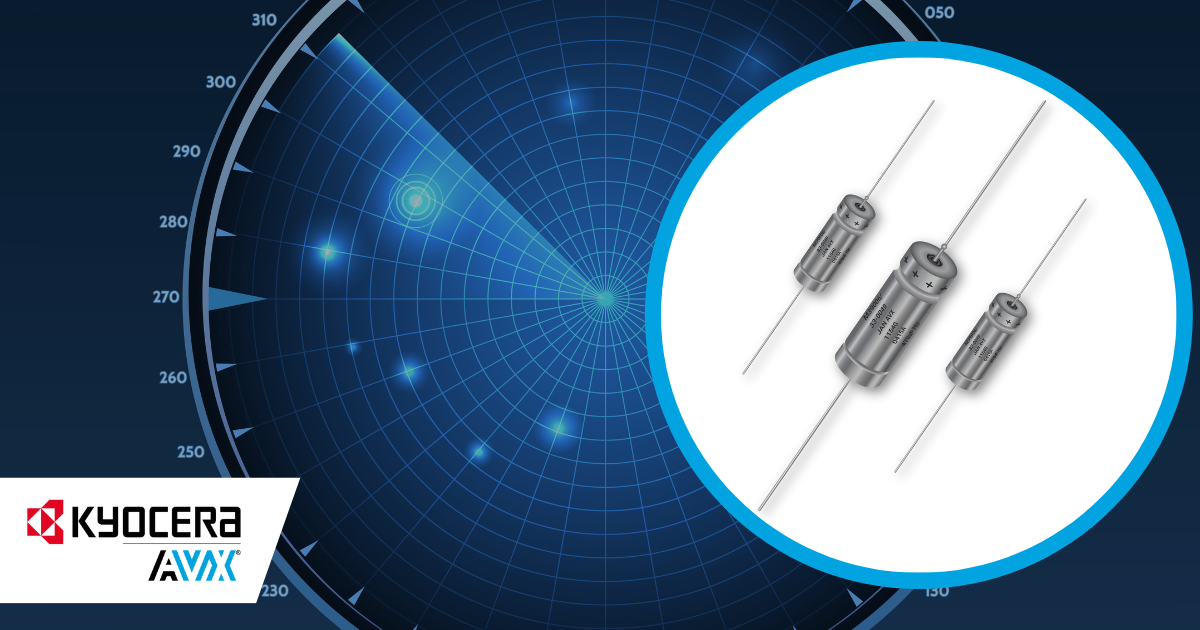
TWA M39006 Series axial-leaded, hermetically sealed wet tantalum capacitors deliver high-reliability, high-CV performance in harsh environment military, defense, avionics, and industrial applications and are now available with both M- & P-level reliabilit
KYOCERA AVX, a leading global manufacturer of advanced electronic components engineered to accelerate technological innovation and build a better future, announced that its TWA Series axial-leaded, hermetically sealed wet electrolytic tantalum capacitors have undergone additional qualification testing to MIL-PRF-39006, FSC 5910 and detail specification sheet MIL-PRF-39006/33, and have had their failure rate extended to include Level P (i.e., 0.1% per 1,000 hours). As a result, the revision of the Qualified Parts List (QPL) 39006 indicates failure rate levels M and P for these products.
KYOCERA AVX’s TWA Series capacitors on the MIL-PRF-39006 QPL (TWA M39006 Series capacitors) are designed to deliver high-reliability, high-CV performance in harsh environment military, defense, avionics, and industrial applications, including satellites, DC/DC power supplies, power converters, bulk energy storage, and pule power circuits. They have a cylindrical, axial-leaded case with a hermetically sealed welded tantalum can and header assembly that ruggedly withstands environmental hazards including shock, vibration, and temperatures extending from -55°C to +125°C, as well as a unique cathode system that provides impressively high CV/cc and stable electrical parameters.
Qualified parts are now available in T3 and T4 case sizes with M-level or P-level reliability (i.e., failure rates of 1% or 0.1% per 1,000 hours, respectively), capacitance values spanning 470–1800µF, and voltage ratings ranging from 25–75V. TWA M39006 Series capacitors also exhibit low DC leakage (5–12µA at +25°C and 20–50µA at +85°C and +125°C) and low ESR (0.5–0.9Ω max. at 120Hz), and are all manufactured at the KYOCERA AVX facility in Lanškroun, Czech Republic, which is qualified to the IATF 16949:2016 quality management system for the design, manufacture, and assembly of tantalum and niobium oxide electrolytic capacitors. Lead-time for the series is currently 18 weeks.
“Qualified parts are critical components of high-reliability systems, so we’re proud of our latest additions to the MIL-PRF-39006 QPL. Our TWA M39006 Series wet tantalum capacitors provide stable, high-reliability, high-CV performance proven to withstand a range of mechanical, electrical, and environmental challenges over long lifetimes, which directly contributes to reduced maintenance requirements and lower total systems costs,” said Allen Mayar, Global Product Manager, Electrolytic Capacitors, at KYOCERA AVX. “In order to extend these benefits to an even greater number of high-reliability applications in critical market areas, we will continue to subject additional capacitance values, voltage ratings, and case sizes to MIL-PRF-39006 qualification testing to further extend the series’ presence on the QPL.”
For more information about KYOCERA AVX’s TWA M39006 Series axial-leaded, hermetically sealed wet tantalum capacitors, including the product datasheet, which will continue to be updated as qualification expands, please go here.