MAX20310 supports a low input voltage of 0.7V to provide wearable PMICs for primary cell architectures
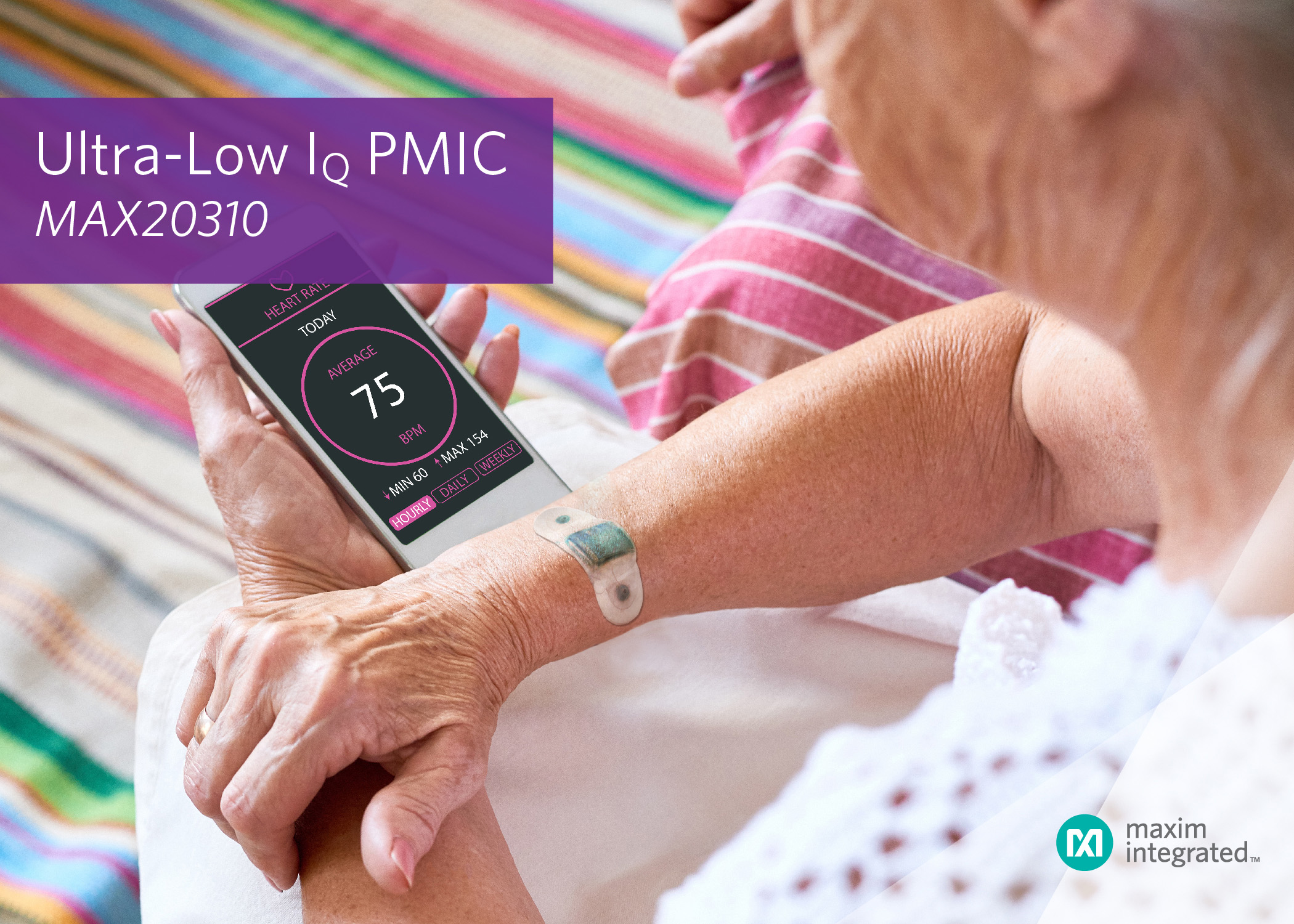
Designers of primary cell wearable medical and fitness applications can now significantly reduce solution size by 50% and extend battery life with the MAX20310 ultra-low quiescent current (IQ) power management integrated circuit (PMIC) from Maxim Integrated Products, Inc. (NASDAQ: MXIM). The wearable PMIC supports a low input voltage of just 0.7V for new high-energy density battery architectures such as Zinc Air and Silver Oxide, as well as the more common Alkaline battery architecture. With personal and remote monitoring gaining traction, reducing size and extending battery life are critical benefits. For example, a report by Allied Market Research projects that the global remote patient monitoring market is expected to grow at a compound annual growth rate (CAGR) of 17% to reach $2.13 billion by 2022.1
There are several factors to consider when designing for wearable medical and fitness applications, including ultra-small form factor and longer battery life. However, designers typically need discrete components to build a sophisticated power tree which can take up precious board space, consume high quiescent current, and burn through battery life when the device is in sleep mode. In clinical environments, there are additional challenges since rechargeable solutions involve contacts, clips, and charging ports where germs may linger.
Using a novel single-inductor multiple-output (SIMO) architecture, the MAX20310 integrates four power outputs from a single inductor each with ultra-low quiescent current performance. This high integration reduces solution size by half over comparable discrete solutions, consuming over 40% less quiescent current and improving battery life as a result. In clinical environments, primary cell architectures can create hermetically sealed units to safely disinfect between use or even dispose of completely to inhibit patient-to-patient infection. The MAX20310 is ideal for applications such as non-rechargeable medical patches, environmental and equipment monitoring, and discrete sensors for industrial internet of things (IIoT). Operating over the -40-degree Celsius to +85-degree Celsius temperature range, the MAX20310 is available in a small, 1.63mm x 1.63mm wafer-level package (WLP).
Key Advantages
- Small Solution Size: Available in a SIMO dual buck-boost architecture with single external inductor; Reduces solution size by 50% compared to discrete solutions
- Versatile Architecture: Supports Zinc Air, Silver Oxide, and Alkaline battery systems with low input voltage of 0.7V to 2V
- Longer Battery Life: Consumes 40% lower quiescent current during sleep or standby mode compared to discrete solutions
-
1 Allied Market Research: https://www.
alliedmarketresearch.com/ remote-patient-monitoring- market